
Front Door Closes but Won’t Stay Latched? 10 Reasons Anaheim Homeowners Should Fix It Before It Gets Worse
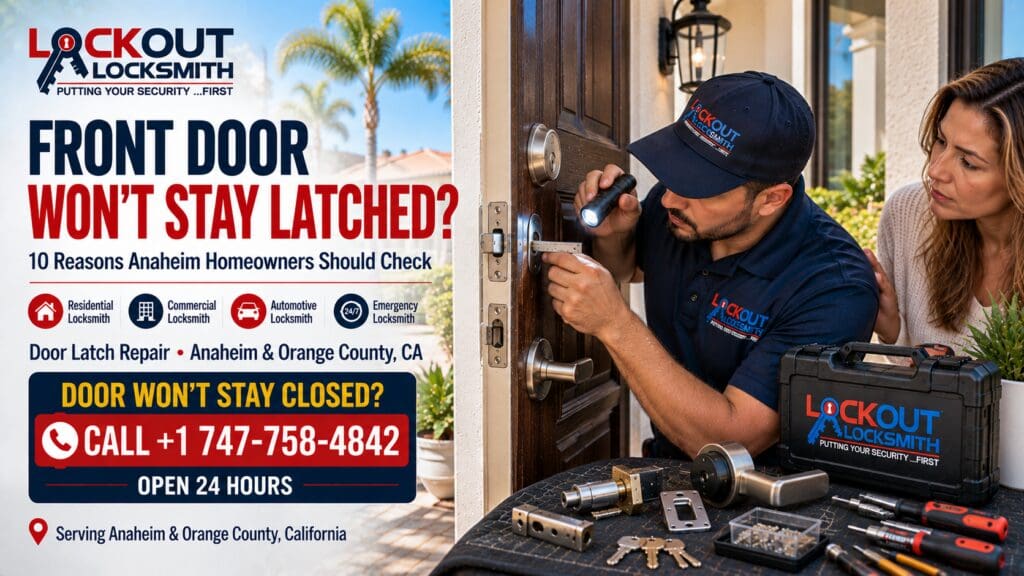
You close your front door, hear what sounds like a normal click, and walk away.
A moment later, the door pushes open.
Maybe a little pressure from the weather moves it. Perhaps someone inside pulls on the handle and realizes the latch never actually caught. Or you discover that the door only stays closed if you lock the deadbolt every single time.
A front door that closes but does not reliably latch can be more than an annoyance.
The latch is designed to hold the door in its normal closed position before the deadbolt is even engaged. If the latch no longer reaches the strike correctly, remains partially retracted, or does not engage deeply enough, the door may not stay shut as expected.
For homeowners in Anaheim and throughout Orange County, California, this type of problem can develop gradually. At first, the door may need a firmer push. Later, you may need to lift the handle or pull the door toward you. Eventually, the latch may stop catching altogether.
That does not automatically mean you need a complete new lockset.
The problem may involve the latch, strike plate, hinges, door position, handle assembly, weather stripping, or another component.
Here are 10 common reasons your front door may close but fail to stay latched—and when professional locksmith service may make sense.
1. The Latch and Strike Are Slightly Misaligned
The most basic requirement is simple:
The spring latch on the edge of the door needs to enter the opening in the strike plate.
If those two points no longer line up, the latch may hit the edge of the strike instead of entering the opening.
You might still hear a sound when the door closes, which makes it seem like the latch engaged.
But a light push may reveal that it never actually caught.
Look for clues such as:
- needing to push harder than before;
- the latch rubbing the strike;
- visible marks around the strike opening;
- or the door staying closed only when you lift or pull it.
A professional providing door latch repair in Anaheim can inspect the alignment instead of simply replacing parts without understanding the cause.
2. The Door Has Shifted Slightly in the Frame
Residential doors can change position over time.
That does not necessarily mean something dramatic has happened to the house.
Regular use, hinges, mounting, seasonal conditions, and other factors can change how the door sits within the opening.
Even a small shift can affect latch engagement.
You may notice that the gaps around the door no longer look as even as they once did.
The top corner may rub.
The door may need to be lifted slightly.
Or the handle may need to be pulled toward you before the latch catches.
If the latch itself works normally with the door open, but fails only when the door closes, the door-to-frame relationship becomes especially important.
A residential locksmith in Anaheim can inspect the lock and latch side of the problem and identify whether additional door work may also be appropriate.
3. The Latch Is Not Extending Fully
A spring latch should extend when the handle is released.
If it remains partly retracted, it may not reach far enough into the strike opening to hold the door closed.
With the door open, operate the handle normally and observe the latch.
Does it move smoothly?
Does it return completely?
Does it hesitate?
Does the handle return to its resting position normally?
A latch that does not fully extend may indicate a mechanical problem in the latch or handle assembly.
Professional front door lock repair in Anaheim can help determine whether the existing hardware can be serviced or should be replaced.
4. The Handle or Lever Is Not Returning Completely
Sometimes the latch is not the only component showing a symptom.
Look at the handle itself.
After you press or turn it, does it spring back to its normal position?
Or does it remain slightly depressed?
A handle that does not fully return may keep the latch partially retracted.
That can prevent reliable engagement with the strike.
You may also notice that the handle feels:
- unusually soft;
- loose;
- sluggish;
- or inconsistent.
A residential lock repair service in Anaheim can inspect the lever, internal mechanism, and latch together.
Do not assume the strike needs adjustment if the latch itself is not returning normally.
5. You Have to Slam the Door to Make It Latch
This is one of the clearest signs that something has changed.
A residential front door should not need to be slammed every time you close it.
If a gentle close no longer works but a hard slam does, you may be forcing the latch into the strike rather than allowing the hardware to operate naturally.
Repeated slamming can also place unnecessary stress on:
- lock hardware;
- hinges;
- trim;
- strike screws;
- the frame;
- and the door itself.
Instead of learning to close the door harder, identify why the latch is no longer engaging normally.
A door lock repair service in Anaheim can inspect the mechanical condition before the problem becomes more severe.
6. The Strike Plate May Be Loose
The strike plate needs to remain securely positioned.
If it moves, shifts, or becomes loose, the latch opening may no longer stay where the lock expects it to be.
Look at the strike without removing anything.
Does it appear secure against the frame?
Does it move when the door closes?
Are visible screws obviously loose?
A loose strike can produce symptoms that look like a bad latch.
But avoid assuming that tightening everything as hard as possible is the right repair.
Hardware needs to be installed correctly, not simply overtightened.
A professional strike plate repair in Anaheim or residential locksmith inspection can help determine what adjustment is actually needed.
7. Weather Stripping May Be Pushing the Door Out of Position
Weather stripping is useful for sealing a door.
However, if the door requires unusually strong pressure to close, the seal may be affecting where the door rests relative to the strike.
One common symptom is a latch that engages only when you firmly push the door inward.
If weather stripping was recently replaced and the problem appeared shortly afterward, mention that when requesting service.
Do not simply remove useful weather sealing without diagnosing the issue.
The goal is to have the door close normally while allowing the latch and deadbolt to operate correctly.
8. The Hinges May Be Affecting Door Position
The latch and strike are on one side of the door.
The hinges are on the other.
But they still affect each other.
If the door is no longer sitting in its normal position, the latch may approach the strike too high, too low, or at a slight angle.
You may notice:
- the door rubbing;
- sagging;
- uneven gaps;
- or needing to lift the handle to latch it.
A locksmith can evaluate whether lock-side hardware is functioning correctly.
If the underlying problem requires significant hinge, door, or structural work, another appropriate door professional may also be needed.
A reputable locksmith in Anaheim, CA should distinguish between lock hardware and broader door problems instead of replacing components unnecessarily.
9. The Latch or Lockset May Be Worn Out
Mechanical hardware does not last forever.
A front door can be opened and closed thousands of times over the life of a lockset.
Eventually, components can wear.
Signs of deteriorating hardware may include:
- sluggish latch movement;
- weak return action;
- excessive handle play;
- repeated failure to latch;
- unusual noise;
- or operation that changes from one day to another.
If the existing hardware is significantly worn, lock replacement in Anaheim may make more sense than repeatedly adjusting a failing assembly.
Related resource:
Replacement should be based on condition—not merely age.
10. The Door and Lock May Have More Than One Problem
Sometimes homeowners look for one single cause when two issues are happening at once.
For example:
The latch mechanism may be wearing out and the strike alignment may have changed.
Or the handle may be loose while the door also needs to be pulled toward the frame.
This is why a proper inspection can be more valuable than guessing.
A mobile locksmith in Anaheim can observe how the complete door operates in the position where the problem occurs.
The right solution may involve adjustment, latch replacement, lockset replacement, strike work, or a combination of appropriate repairs.
Door Won’t Stay Closed Unless Deadbolt Is Locked
This symptom deserves attention.
A deadbolt is designed to provide locking security.
It should not need to function as the only thing physically holding a normally closed door in place because the spring latch has stopped working properly.
If the door swings or pushes open whenever the deadbolt is unlocked, the latch is not doing its normal job.
Have the latch and strike inspected.
Continuing to rely exclusively on the deadbolt may hide the underlying problem.
Why Does My Door Latch Only If I Push It Hard?
Pressure changes where the door sits relative to the frame.
If pushing inward suddenly allows the latch to catch, that tells you something about the relationship between the latch and strike.
The issue may involve:
- alignment;
- door position;
- weather stripping;
- latch travel;
- or another mechanical condition.
That observation is worth sharing with your Anaheim residential locksmith.
For example:
“The door closes normally, but the latch only catches if I push firmly on the door.”
That is much more useful than saying:
“My lock is broken.”
Why Does My Door Latch Only If I Lift the Handle?
If lifting the handle or door changes the latch position, the door itself may not be sitting exactly where it used to.
That does not necessarily mean the lockset needs replacement.
Check whether the door also rubs or has uneven gaps.
Tell the locksmith that lifting the door changes the symptom.
That information may help distinguish latch failure from alignment-related problems.
Can a Locksmith Repair a Door That Won’t Stay Latched?
A locksmith can often evaluate conventional latch, lockset, strike, and related door hardware.
Depending on the condition, appropriate service might include:
- latch repair;
- handle/lever service;
- strike adjustment;
- lockset replacement;
- cylinder service;
- or another compatible hardware repair.
If the underlying problem is primarily structural—such as major door-frame damage—a different type of professional may also be needed.
The diagnosis should determine the service.
Should You Move the Strike Plate Yourself?
It may look simple.
If the latch is missing the opening, move the strike.
But that is not always the correct first step.
If the door is sagging or the latch mechanism is failing, moving the strike can simply adapt the hardware to another unresolved problem.
The better sequence is:
- identify why the latch is not engaging;
- determine which component has changed;
- make the appropriate correction.
Avoid enlarging or modifying the frame repeatedly without understanding the cause.
Should You Replace the Entire Lockset?
Not automatically.
If the latch mechanism is serviceable and another condition is responsible, complete replacement may not be necessary.
But lock replacement in Anaheim may be appropriate when:
- the latch mechanism is badly worn;
- the handle assembly is failing;
- hardware is damaged;
- multiple components are unreliable;
- or the existing lock no longer meets your needs.
If replacement is recommended, ask the locksmith to explain what has failed.
Does Rekeying Fix a Door That Won’t Stay Latched?
No.
Rekeying addresses key control.
It changes which physical key operates compatible lock cylinders.
A lock rekey service in Anaheim may be useful after:
- moving into a home;
- losing a key;
- changing authorized users;
- or becoming unsure who has previous copies.
But rekeying does not inherently fix a spring latch that is failing to engage.
Related information:
Should You Check the Deadbolt Too?
Yes.
If one part of the door hardware has changed, it is reasonable to observe how the deadbolt operates as well.
Does it extend smoothly?
Does it align with the strike?
Do you need to push or pull the door?
A door-position issue can sometimes affect both the latch and deadbolt.
If the deadbolt itself needs attention, professional deadbolt repair in Anaheim may be appropriate.
For replacement:
Could a Smart Lock Solve the Problem?
Not by itself.
A smart lock can improve access convenience, but it does not correct a door that fails to close or latch properly.
If the mechanical door problem remains, an electronic deadbolt may encounter the same alignment issues.
Before smart lock installation in Anaheim, make sure the door, latch, strike, and deadbolt operate correctly.
Related information:
What About a Keypad Lock?
The same principle applies.
A keypad door lock installation in Anaheim can provide convenient code access.
But electronic access should be installed on mechanically sound door hardware.
If the door requires slamming before the latch catches, installing a keypad does not solve that mechanical condition.
Fix the door operation first.
Related resource:
Can a Door That Won’t Latch Cause a Lockout?
It can create different access problems depending on how the mechanism fails.
For example, a worn latch may eventually become stuck in the extended position.
If that happens while the door is closed, turning the handle may no longer release it normally.
If legitimate access is lost, house lockout service in Anaheim may be appropriate.
Related resource:
Once access is restored, make sure the underlying latch problem is repaired.
When Is a Door-Latch Problem an Emergency?
A door that occasionally needs a slightly firmer close is not automatically an emergency.
More urgent locksmith assistance may be appropriate when:
- an exterior door will not stay securely closed;
- the latch is stuck;
- the door cannot be opened normally;
- the lockset has failed completely;
- you cannot gain legitimate access;
- or an important entrance cannot be secured.
In those circumstances, an emergency locksmith in Anaheim may be appropriate.
Lockout Locksmith lists its hours as Open 24 Hours.
Internal resource:
A Simple 60-Second Door-Latch Test
Homeowners can gather useful information without dismantling anything.
Step 1 — Open the door
Operate the handle several times normally.
Step 2 — Watch the latch
Does it retract completely?
Step 3 — Release the handle
Does the latch fully extend again?
Step 4 — Watch the handle
Does it return to the normal resting position?
Step 5 — Close the door gently
Does the latch engage?
Step 6 — Test the closed door
Without locking the deadbolt, does the latch hold the door normally?
Step 7 — Notice pressure
Do you need to push, pull, lift, or slam the door?
Step 8 — Stop before forcing hardware
If normal operation has clearly changed, consider professional inspection.
Mid-September Is a Practical Time for This Check in Anaheim
Mid-September in Anaheim and Orange County, California is still warm.
There is no need to pretend Southern California suddenly turns into a cold autumn climate.
But household routines have changed.
School is underway.
Summer travel has slowed.
Front doors and garage entries are getting used in predictable morning and evening routines again.
That makes September a useful time to catch little problems everyone may have tolerated during summer.
A door that only needs a small push today may require a hard slam a month from now.
Addressing the cause earlier is usually more convenient.
Choosing a Door Lock Repair Service in Anaheim
When calling a locksmith, describe the exact symptom.
Useful examples include:
“The latch retracts normally with the door open but misses the strike when I close it.”
“The handle turns, but the latch does not extend all the way after I release it.”
“The door only stays closed if I use the deadbolt.”
“I have to lift the front door before the latch catches.”
These details help a mobile residential locksmith in Anaheim understand what type of problem is occurring.
Depending on the diagnosis, appropriate service may include door latch repair, door lock repair, strike plate service, lock replacement, deadbolt work, or another hardware adjustment.
Need Door Latch Repair in Anaheim?
If your front door closes but pops back open, only stays shut when the deadbolt is locked, needs to be slammed, or requires pushing or lifting before the latch catches, the issue is worth inspecting.
Lockout Locksmith provides mobile residential, automotive, and emergency locksmith services throughout Anaheim and Orange County, California.
Depending on your hardware and situation, services may include door latch repair, residential lock repair, door lock repair, lock rekeying, lock replacement, deadbolt installation, smart lock installation, keypad lock installation, house lockout assistance, and emergency locksmith service.
Frequently Asked Questions
Why does my front door close but not stay latched?
The latch may not be entering the strike opening correctly, the door may have shifted, the latch may not be extending completely, or the handle/strike hardware may need inspection.
Why do I have to slam my front door to make it latch?
If harder closing is required, the latch and strike may no longer be interacting normally. The cause should be diagnosed instead of continually slamming the door.
Why does my door only latch if I push it?
Pushing changes the position of the door relative to the strike. Alignment, weather stripping, door position, or latch operation may be involved.
Can a locksmith fix a door that won’t stay latched?
A locksmith can evaluate conventional latch, handle, strike, and lockset hardware. Depending on the cause, repair, adjustment, or replacement may be appropriate.
Do I need a whole new lock if the latch won’t catch?
Not necessarily. The correct solution depends on whether the problem involves the latch, handle assembly, strike, door position, or damaged lock hardware.
Will rekeying fix a door-latch problem?
No. Rekeying changes which key operates compatible lock cylinders. It does not inherently repair a latch or strike-alignment problem.
Can a smart lock fix a door that won’t latch?
No. Smart or keypad locks still depend on properly functioning mechanical door hardware. Correct the underlying mechanical problem first.
Is a door that won’t stay latched an emergency?
It can become more urgent if an important exterior door cannot remain closed or secured, the latch becomes stuck, or the malfunction prevents legitimate access.
Lockout Locksmith
Address: 1096 N Anaheim Blvd, Anaheim, CA 92801
Phone: +1 747-758-4842
Service Area: Anaheim & Orange County, California
Hours: Open 24 Hours
Serving Anaheim & Orange County, California with mobile residential, automotive, and emergency locksmith services.
See Our Recent Customer Reviews
See our recent customer reviews on our Google Business Profile to learn about local customers’ experiences with Lockout Locksmith.