
Door Handle Turns but Latch Won’t Retract? 9 Reasons Anaheim Homeowners Shouldn’t Ignore It
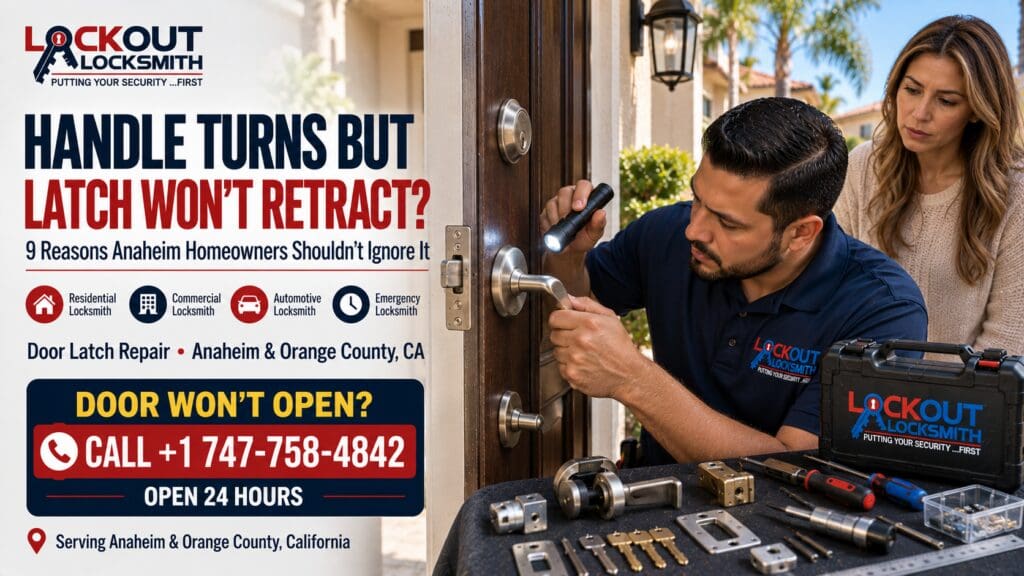
You turn your front-door handle expecting the latch to slide back into the door.
The handle moves.
But the latch barely moves—or does not retract at all.
You try again. Maybe lifting the handle helps. Maybe pushing the door changes something. Perhaps the problem disappears when the door is open but comes back as soon as you close it.
It is easy to dismiss a troublesome latch because the deadbolt still works. But the latch, handle, strike, and door alignment all contribute to how your entry door operates every day.
For homeowners in Anaheim and throughout Orange County, California, a door handle that turns without properly retracting the latch deserves attention before it becomes a complete access problem.
Sometimes the cause is straightforward. Other times, worn hardware, a loose handle assembly, internal mechanical failure, latch binding, or door alignment can be involved.
Here are nine common possibilities and what homeowners should know before forcing the hardware.
1. The Handle Moves but Is No Longer Operating the Latch Correctly
Start with the most obvious symptom.
When you turn a working residential lever or knob, that movement should operate the latch mechanism.
If the handle rotates but the latch remains extended, something between those components may no longer be transferring movement normally.
You might notice that the handle suddenly feels unusually light.
There may be more movement than before, or the handle might rotate farther without producing the expected response.
That does not necessarily mean the entire lockset must be replaced.
A professional providing door lock repair in Anaheim can inspect the handle, latch, and related components to determine what has actually failed.
Avoid repeatedly turning the handle harder. More force does not repair a disconnected or malfunctioning mechanism.
2. The Latch Retracts Only Partway
Sometimes the latch still moves but no longer retracts completely into the door edge.
That small difference can be enough to keep the door caught against the strike plate.
Pay attention to how much of the latch remains visible when you fully operate the handle.
Does it retract smoothly?
Does it stop partway?
Does it move differently depending on how far you turn the handle?
Partial movement can indicate a problem within the latch or handle mechanism.
An Anaheim residential locksmith can inspect the existing hardware and determine whether repair, adjustment, or replacement is appropriate.
3. The Latch Works With the Door Open but Not When Closed
This is an especially useful observation.
Open the door and operate the handle normally.
If the latch retracts smoothly, the mechanism can at least move while the door is not interacting with the frame.
Now close the door carefully and test normal operation again.
If the problem appears only after the door closes, pressure or alignment between the latch and strike may be involved.
This does not automatically tell you exactly what moved.
However, it gives a residential locksmith in Anaheim valuable diagnostic information.
Tell the technician:
“The latch works normally with the door open, but it sticks when the door is closed.”
That is much more useful than simply saying the door is broken.
4. You Have to Push the Door Before the Handle Works
Have you developed a habit of pushing your front door while turning the handle?
Many homeowners do this without realizing it.
At first, it may require only a small amount of pressure.
Later, you may find yourself pushing harder.
Eventually, the latch may refuse to release normally.
When pushing or pulling the door changes how the latch operates, the relationship between the door and strike deserves attention.
A professional front door lock repair service in Anaheim can evaluate the latch hardware and how it interacts with the strike and frame.
The solution should address why the latch is binding—not simply teach you to push harder.
5. The Door Handle Has Become Loose or Wobbly
A loose lever or knob is more than a cosmetic annoyance.
Residential door hardware is designed so that its components work together in a specific position.
If the handle assembly becomes noticeably loose, movement may become inconsistent.
Watch the hardware while operating it normally.
Does the trim shift against the door?
Does the lever sag?
Does the knob wobble?
Does the entire assembly move instead of just the handle?
These are useful warning signs.
A lock repair service in Anaheim, CA can inspect the mounting and internal operation.
Avoid randomly tightening visible screws as hard as possible. Overtightening is not the same as correctly servicing the hardware.
6. The Handle Does Not Spring Back Normally
A residential lever typically returns toward its normal resting position after you release it.
If yours stays partially down, rises slowly, or feels unusually weak, pay attention.
The return behavior can provide clues about the condition of the mechanism.
You may also notice that the latch remains partially retracted after releasing the handle.
A failing return action can make the door unreliable in both directions.
It may not latch properly when you close it, or it may not release properly when you try to open it.
This is a good reason to consider residential lock repair in Anaheim before the mechanism becomes completely unusable.
7. The Latch Is Binding Against the Strike Plate
Look at the point where the latch enters the strike opening when the door closes.
You do not need to remove anything.
Simply observe normal operation.
Does the latch contact the strike unusually hard?
Do you see obvious rubbing?
Do you need to lift, push, or pull the door?
Does the door bounce back unless you close it firmly?
These clues may indicate that the latch and strike are not interacting normally.
Do not immediately start filing or enlarging the strike opening.
If the relationship changed because the door itself shifted, modifying the strike without understanding the cause may only mask the problem.
A professional door latch repair service in Anaheim can inspect the full situation first.
8. The Latch Mechanism Is Worn
Residential entry hardware gets used repeatedly.
Think about how many times your front door opens and closes every week.
Over time, mechanical components can wear.
A latch that once operated smoothly may gradually become:
- stiff;
- slow;
- inconsistent;
- noisy;
- difficult to retract;
- or unable to return properly.
Progressive deterioration is especially important.
If the problem has been getting worse for several weeks, waiting for complete failure offers little advantage.
A mobile locksmith in Anaheim can inspect the hardware while the door is still usable.
Depending on its condition, the solution may involve servicing existing components or installing appropriate replacement hardware.
9. The Latch Has Failed Completely
Eventually, a worn or damaged mechanism may stop responding.
The handle turns, but the latch stays extended.
If the door is already closed, that can create a legitimate access problem.
Avoid kicking the door, forcing the handle, prying the frame, or attempting destructive entry.
Damage to a door or frame can become considerably more expensive than the original lock problem.
If you cannot legitimately enter your home because the latch has failed, house lockout service in Anaheim may be appropriate.
Lockout Locksmith provides mobile service throughout Anaheim and Orange County, California.
Related resource:
Door Latch vs. Deadbolt: They Are Not the Same Thing
Homeowners sometimes use “lock” to describe every piece of hardware on the door.
But it helps to distinguish between components.
The spring latch is generally operated by your knob or lever.
The deadbolt is a separate locking component on many residential entry doors.
That distinction matters when describing the problem to a locksmith.
For example:
Problem A:
“My key turns but the deadbolt won’t retract.”
Problem B:
“The deadbolt is unlocked, but turning the handle doesn’t retract the latch.”
Those are different symptoms and may require different diagnoses.
Giving your Anaheim locksmith the correct symptom helps them understand the service request.
Why Does My Door Latch Work When the Door Is Open?
If the latch works perfectly with the door open, you have learned something important.
The mechanism is capable of moving when the strike and frame are not involved.
If the same latch binds when the door is closed, the door-to-frame interaction becomes more relevant.
That does not mean you should immediately move the strike plate.
The underlying reason should be identified first.
The door position, hinges, latch, strike, hardware installation, or a combination of factors may need evaluation.
Why Do I Have to Lift the Door Handle?
If lifting the handle or slightly lifting the door changes whether the latch releases, the door may not be sitting in exactly the same position it once did.
Look at the gaps around the door.
Does anything appear uneven?
Does the door rub?
Has closing become noticeably different?
A locksmith can evaluate the lock and latch portion of the problem.
If the underlying condition involves other door components beyond the scope of locksmith work, a reputable technician should be able to explain what they observed rather than pretending every door problem can be solved by replacing a lock.
Should You Spray Lubricant Into a Sticking Latch?
Not every sticking latch is a lubrication problem.
If the handle is mechanically disconnected, lubricant will not reconnect it.
If the latch is binding against the strike because of alignment, lubricant will not realign the door.
And applying random household products can introduce unnecessary residue into hardware.
Follow the lock manufacturer’s maintenance recommendations when available.
If the mechanism is clearly malfunctioning, diagnosis should come before experimentation.
Can You Fix a Door Latch Yourself?
Basic observation is reasonable.
You can safely check whether:
- the latch moves with the door open;
- the handle returns normally;
- the hardware appears loose;
- the problem changes when the door closes;
- the strike shows unusual contact;
- and the condition is becoming progressively worse.
What you should avoid is aggressive or destructive experimentation.
If an exterior door is involved, reliable operation matters for both access and security.
Professional door lock repair in Anaheim may be appropriate when normal operation cannot be restored without dismantling or modifying the hardware.
Door Latch Repair vs. Lock Replacement
A malfunction does not automatically mean you need every piece of hardware replaced.
Repair or Adjustment
Repair may make sense when the hardware remains suitable and the specific issue can reasonably be corrected.
Replacement
Lock replacement in Anaheim may make more sense when components are damaged, significantly worn, unreliable, incompatible, or no longer functioning as intended.
If a technician recommends replacement, ask why.
A clear explanation should identify what is wrong with the existing hardware and what the replacement addresses.
Related service:
Should You Rekey the Lock at the Same Time?
Rekeying and latch repair solve different problems.
A lock rekey service in Anaheim changes which key operates compatible lock hardware.
Rekeying can make sense when:
- you recently moved;
- a key was lost;
- previous occupants may have copies;
- access permissions have changed;
- or you want compatible locks keyed appropriately.
But rekeying does not inherently fix a failed door latch.
If you need both mechanical repair and key-control changes, discuss both requirements during the service visit.
Related information:
What About Installing a New Deadbolt?
If the latch is malfunctioning, replacing the deadbolt alone may not correct it because these can be separate components.
However, if you are already reviewing older front-door hardware, it may be a reasonable time to inspect the deadbolt too.
A professional deadbolt installation in Anaheim should consider the door, frame, strike preparation, existing hardware, and normal operation.
Related service:
Could You Upgrade to a Smart or Keypad Lock?
Possibly.
If existing hardware needs replacement, some homeowners use the opportunity to consider electronic access.
Options may include smart lock installation in Anaheim or keypad door lock installation in Anaheim, depending on the door and household needs.
But electronic features do not compensate for a door that mechanically binds.
Before upgrading, the door should close and operate correctly.
Related resources:
When Does a Broken Door Latch Become an Emergency?
A minor change in handle feel is not automatically an emergency.
The situation becomes more urgent when:
- you cannot legitimately enter your home;
- you cannot reliably close an exterior door;
- the latch is stuck with the door closed;
- an important entrance cannot be secured;
- or the hardware has completely stopped operating.
In these circumstances, a 24 hour locksmith in Anaheim may be useful.
Lockout Locksmith is Open 24 Hours for locksmith service throughout Anaheim and Orange County, California.
Related resource:
Why Check Your Door Hardware in September?
Early September in Anaheim and Orange County, California still feels like Southern California—not a stereotypical cold fall season.
But household routines change.
School is back in session. Summer travel slows down. Work schedules become more regular, and families begin using their main entry doors according to more predictable daily routines.
That makes September a practical time to notice small mechanical problems that may have been ignored during summer.
Try each regularly used exterior entrance.
Does the handle operate smoothly?
Does the latch retract completely?
Does the door close without being slammed?
Does the latch engage naturally?
Does the deadbolt lock without pushing or pulling the door?
Small changes can be worth addressing before they become bigger access problems.
8 Warning Signs to Call a Residential Locksmith
Consider scheduling a residential locksmith in Anaheim if:
- The handle turns but the latch does not move.
- The latch retracts only partway.
- The handle feels loose or unusually light.
- The lever no longer returns normally.
- You must push the door before opening it.
- You must lift the handle or door.
- The latch works open but binds when closed.
- An exterior door cannot be opened or secured normally.
The goal is not to wait for every problem to become an emergency lockout.
Choosing the Right Locksmith Service in Anaheim
Describe exactly what the door is doing when you request service.
Instead of saying:
“My lock is broken.”
Try:
“The front-door lever turns, but the latch doesn’t retract.”
Or:
“The latch works when the door is open but gets stuck against the frame when it’s closed.”
That helps a mobile residential locksmith in Anaheim understand the situation more accurately.
Depending on the diagnosis, the appropriate service may include:
- door latch repair;
- residential door lock repair;
- lock replacement;
- deadbolt repair;
- lock rekeying;
- hardware adjustment;
- smart lock installation;
- keypad lock installation;
- or house lockout assistance.
Need Door Lock Repair in Anaheim?
A door handle that turns without properly retracting the latch should not require increasingly aggressive force every day.
If your front-door latch is sticking, binding, moving only partway, or failing completely, Lockout Locksmith provides mobile locksmith services throughout Anaheim and Orange County, California.
Our services include residential lock repair, door lock repair, lock rekeying, lock changes, deadbolt installation, smart lock installation, keypad lock installation, house lockout assistance, automotive locksmith services, and emergency locksmith assistance depending on your needs.
FAQ
Why does my door handle turn but the latch won’t retract?
The handle may no longer be transferring movement correctly to the latch, the latch mechanism may be worn or damaged, or the latch may be binding due to door and strike alignment.
Why does my door latch work when the door is open but not closed?
If it works normally while open but binds after closing, the interaction between the latch, strike, door, and frame may be contributing to the problem.
Can a locksmith repair a door latch?
Depending on the hardware and cause of the malfunction, a locksmith may be able to adjust, repair, or replace the affected residential lock hardware.
Why do I have to push my door before the latch releases?
Pressure between the latch and strike can interfere with normal movement. The reason for the pressure or alignment change should be identified rather than simply forcing the handle.
Should I replace the entire lock if the latch is broken?
Not automatically. The appropriate solution depends on the type, condition, and failure of the installed hardware.
Will rekeying fix a broken door latch?
No. Rekeying changes which key operates compatible lock hardware. It does not inherently repair a mechanically failed latch.
Can a stuck latch cause a house lockout?
Yes. If the latch remains extended while the door is closed, it can prevent normal authorized entry even when the deadbolt is unlocked.
Should I call an emergency locksmith for a stuck door latch?
If the malfunction prevents legitimate access to your home or prevents an exterior door from being secured, urgent locksmith assistance may be appropriate.
Lockout Locksmith
Address: 1096 N Anaheim Blvd, Anaheim, CA 92801
Phone: +1 747-758-4842
Service Area: Anaheim & Orange County, California
Hours: Open 24 Hours
Serving Anaheim & Orange County, California: Lockout Locksmith provides mobile residential, automotive, and emergency locksmith services throughout Anaheim and Orange County, CA.
See Our Recent Customer Reviews
See our recent customer reviews on our Google Business Profile to learn about local customers’ experiences with Lockout Locksmith.