
Front Door Lock Makes a Grinding or Scraping Sound? 9 Reasons Anaheim Homeowners Should Have It Checked
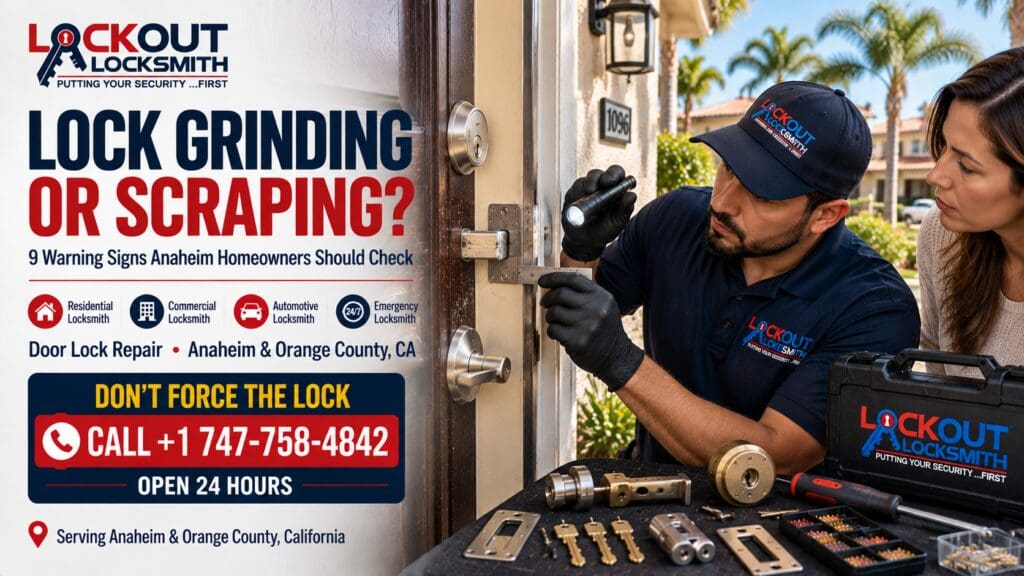
Most homeowners do not think much about the sound their front-door lock makes.
When everything is working normally, you insert the key, turn it, operate the deadbolt, and go inside. The process is so routine that you probably do it without thinking.
Then one day something sounds different.
Maybe there is a faint scrape when the deadbolt moves. Perhaps the key produces a rough grinding sensation inside the cylinder. You may hear metal rubbing when locking the door, or the sound may appear only when the door is completely closed.
The lock may still work, which makes the problem tempting to ignore.
But a new grinding, scraping, clicking, or rubbing sound can be useful information. It does not automatically mean the lock needs replacement, but it may indicate that some part of the lock, bolt, strike, cylinder, or door alignment is no longer operating the way it previously did.
For homeowners in Anaheim and Orange County, California, identifying the cause while the door still works normally can be considerably more convenient than waiting until an exterior lock becomes difficult—or impossible—to operate.
Here are nine things worth checking.
1. The Deadbolt May Be Rubbing Against the Strike
One of the first things to notice is when the sound occurs.
Does your deadbolt move quietly when the front door is open?
Now close the door and operate it again.
If you hear scraping only when the door is closed, the bolt may be contacting the strike area as it extends or retracts.
This distinction matters.
The cylinder itself might not be the source of the problem.
Small changes in how a door sits in its frame can affect the path of the deadbolt. A bolt that previously entered the strike opening cleanly may begin contacting an edge.
You might also notice that turning the key requires slightly more pressure.
A professional providing door lock repair in Anaheim can inspect the relationship between the deadbolt, door, frame, and strike rather than replacing parts based on guesswork.
2. The Keyed Cylinder Sounds Rough
What if the grinding sensation happens even while the door is open?
Pay attention to where you feel it.
Insert your normal authorized key and operate the lock gently.
If the rough sensation seems to come directly from the keyed cylinder, the cylinder or key may deserve closer inspection.
Look at the key as well.
Is it straight?
Are there visible cracks?
Is it unusually worn compared with a spare?
Does another properly cut household key behave differently?
These observations can help an Anaheim residential locksmith determine whether the problem appears related to the key, cylinder, or another component.
Do not repeatedly force a rough cylinder just because it still turns.
3. The Lock Makes Noise Only When You Lock the Door
A lock can behave differently depending on the direction of movement.
Maybe unlocking feels completely normal.
But when you extend the deadbolt, you hear scraping.
That is useful diagnostic information.
Try the same motion while the door is open.
If the noise disappears, pay attention to how the bolt interacts with the strike when the door closes.
If the sound remains even with the door open, the source may be within the hardware itself.
When contacting a residential locksmith in Anaheim, describe exactly what happens:
“The deadbolt unlocks smoothly, but I hear scraping when I lock it.”
That is more useful than simply saying the lock is noisy.
4. You Have Started Pushing the Door While Turning the Key
Many lock problems create little habits before homeowners recognize there is an issue.
You may start pushing the front door inward while turning the key.
Or perhaps you pull the handle toward you before the deadbolt will move quietly.
If applying pressure to the door changes the sound or resistance, the interaction between the door and locking hardware deserves attention.
This is particularly relevant when the lock works smoothly with the door open.
A front door lock repair service in Anaheim can inspect the alignment and hardware to identify why normal operation has changed.
The goal should not be to teach yourself a stronger push-and-turn routine.
The goal is to understand why it became necessary.
5. The Deadbolt Is Scraping the Edge of the Strike Opening
Sometimes there is visible evidence.
Without dismantling anything, look at the strike plate and bolt area.
You may notice fresh rubbing or polished metal where components repeatedly contact each other.
Do not immediately start enlarging the strike opening yourself.
Visible rubbing tells you where contact occurs, but it does not necessarily explain why the relationship changed.
For example, simply modifying the strike may mask a different door-position issue.
A professional deadbolt repair service in Anaheim can evaluate the full operation before deciding what adjustment is appropriate.
6. The Lock or Trim Is Becoming Loose
Listen to the sound while watching the exterior hardware.
Does the cylinder or trim move against the door when you turn the key?
Does the deadbolt assembly feel less secure than it used to?
Does the interior thumb turn wobble?
Loose mounting can affect how lock components interact.
If a part that should remain securely positioned starts shifting during operation, you may hear rubbing, clicking, or other unusual mechanical sounds.
This is different from normal key movement.
A mobile locksmith in Anaheim can inspect the mounting and condition of the hardware.
Avoid simply tightening every visible screw as hard as possible. Correct installation and excessive tightening are not the same thing.
7. The Door Latch Is Making the Noise, Not the Deadbolt
Homeowners often refer to every piece of door hardware as “the lock.”
But your entrance may have multiple components.
There may be:
- a keyed deadbolt;
- a spring latch;
- a lever or knob;
- a strike plate;
- and separate trim or mounting hardware.
If the scraping occurs when you close the door rather than when you turn the deadbolt, the spring latch may be involved.
Try operating the handle while the door is open.
Does the latch retract smoothly?
Does it return normally?
Does closing the door create the scraping sound?
This distinction can help a door latch repair service in Anaheim diagnose the problem more efficiently.
8. The Lock Is Getting Harder to Operate Along With the Noise
Sound alone is one clue.
Sound combined with increasing resistance deserves more attention.
For example:
Last month, you noticed a faint scrape.
Now the key requires more effort.
Next, you find yourself pulling the door before the deadbolt retracts.
That progression suggests the condition is changing rather than remaining a harmless sound.
Do not wait until you need enough force to bend the key.
If the lock is becoming progressively harder to operate, consider scheduling lock repair in Anaheim while you can still use the entrance normally.
9. Older Hardware May Be Approaching the End of Its Useful Service Life
Residential locks are mechanical devices.
They are operated repeatedly over years.
Eventually, some hardware can become worn, damaged, loose, or unreliable.
That does not mean every noisy older lock should immediately be replaced.
Condition matters more than age alone.
A locksmith can inspect whether the existing hardware remains suitable for service.
If repair or adjustment is reasonable, replacement may not be necessary.
If significant wear or damage is present, lock replacement in Anaheim may become the more practical option.
Ask the technician to explain what they found and why a particular solution is recommended.
Grinding vs. Scraping vs. Clicking: Does the Sound Matter?
It can help describe the symptom, although homeowners do not need to diagnose the mechanism themselves.
Scraping
A scraping sound may suggest that two surfaces are contacting during movement.
Grinding
A rough grinding sensation may feel as though movement inside the mechanism is no longer smooth.
Clicking
Some clicking is normal in lock operation. A new or unusual click combined with incomplete operation is more relevant.
Rubbing
Rubbing that occurs only when the door is closed may point attention toward how hardware interacts with the frame or strike.
The important question is:
Has the sound changed from the way the lock normally operated?
Why Does My Deadbolt Scrape Only When the Door Is Closed?
This is one of the most useful tests a homeowner can perform without taking anything apart.
With the door open, extend and retract the deadbolt normally.
If everything moves smoothly and quietly, close the door.
Try again.
If scraping appears only after closing, the interaction between the bolt and strike becomes especially relevant.
You may also notice that pushing, pulling, or slightly lifting the door changes the result.
Tell your locksmith in Anaheim, CA about these observations.
They can significantly improve diagnosis.
Why Is My Front Door Lock Grinding When I Turn the Key
If the roughness seems to come directly from the cylinder, several possibilities may need evaluation.
The condition of the key matters.
So does the condition of the cylinder and the rest of the lock mechanism.
Do not assume that one spray of lubricant will automatically solve the issue.
If the lock has become progressively rough or difficult to operate, professional lock cylinder repair in Anaheim or another appropriate lock service may be worth considering.
Should I Lubricate a Grinding Door Lock?
Maintenance recommendations vary by manufacturer and hardware.
More importantly, not every noisy lock is suffering from a lubrication problem.
If the deadbolt is physically rubbing the strike, adding lubricant to the keyway does not correct alignment.
If hardware is loose, lubricant does not secure it.
If a component is damaged, lubricant does not restore it.
Before applying random household oils or sprays, check the manufacturer’s recommendations or have the actual cause diagnosed.
Don’t Force a Noisy Lock
This is especially important.
When a lock starts resisting movement, homeowners sometimes compensate by turning the key harder.
That can create additional problems.
Your house key is designed to operate the lock—not function as a high-torque lever.
If you feel substantial resistance, stop.
Repeated excessive force can stress the key and potentially leave you dealing with both the original lock problem and a damaged key.
Could the Key Break Inside the Lock?
Yes, particularly if a key is already worn, cracked, bent, or repeatedly subjected to excessive twisting force.
A lock that is grinding and becoming difficult to turn should therefore be treated differently from one that merely makes a harmless familiar sound.
If you notice the key flexing or bending while operating the lock, stop forcing it.
A professional residential locksmith in Anaheim can inspect why the lock requires excessive force.
Does a Noisy Lock Need to Be Replaced?
Not automatically.
The appropriate service depends on the diagnosis.
Lock Repair
Residential lock repair in Anaheim may make sense when the existing hardware is still serviceable and the specific problem can reasonably be corrected.
Lock Replacement
Lock replacement in Anaheim may make more sense when the hardware is significantly worn, damaged, unreliable, or unsuitable for continued service.
Related resource:
Do not replace the entire lock solely because you heard one unusual sound.
But do not ignore a progressively worsening mechanical problem either.
Should You Rekey a Noisy Lock?
Rekeying addresses key control.
It does not inherently repair scraping or grinding.
A lock rekey service in Anaheim may be useful when:
- you recently moved;
- a key was lost;
- you are unsure who has copies;
- household access has changed;
- or you want compatible locks to operate with a different key.
If the same lock also has a mechanical problem, mention both issues.
Related resource:
What If the Deadbolt Is the Problem?
If diagnosis shows that the deadbolt itself is worn or malfunctioning, repair or replacement may be appropriate depending on its condition.
For replacement hardware, proper installation matters.
A new deadbolt should operate smoothly with the door and strike—not require force immediately after installation.
For homeowners considering an upgrade, professional deadbolt installation in Anaheim may be appropriate.
Related resource:
Could You Upgrade to a Smart Lock Instead?
If replacement is genuinely needed, some homeowners use the opportunity to consider electronic access.
A smart lock installation in Anaheim may provide features such as keyless entry or access management depending on the chosen product.
But a smart lock should not be used to hide an underlying door-alignment issue.
Electronic deadbolts still depend on mechanical bolt movement.
The door should operate correctly first.
Related resource:
What About Keypad Entry?
A keypad door lock installation in Anaheim can also be an option for homeowners who prefer code-based entry.
Before installing one, the locksmith should consider compatibility and normal mechanical operation of the entrance.
If an existing deadbolt is scraping because the door is putting pressure on the bolt, that condition should be addressed before expecting a new electronic lock to solve it.
Related resource:
When Does a Noisy Lock Become an Emergency?
A scraping sound by itself does not automatically require emergency service.
The situation becomes more urgent when:
- the key will no longer turn normally;
- the deadbolt cannot retract;
- the door cannot be locked;
- the key becomes stuck;
- the key breaks;
- you cannot legitimately enter your home;
- or an exterior entrance cannot be secured.
In those circumstances, an emergency locksmith in Anaheim may be appropriate.
Lockout Locksmith is Open 24 Hours for locksmith service in Anaheim and throughout Orange County, California.
Related resource
What If the Lock Jams Completely?
If you are legitimately locked out because the mechanism no longer operates, avoid turning a lock problem into a door-and-frame repair problem.
Do not kick, pry, or attempt destructive entry.
Professional house lockout service in Anaheim may be the appropriate next step.
Related resource:
Once access is restored, make sure the cause of the original malfunction is evaluated.
A Simple Homeowner Check Before Calling a Locksmith
You can collect useful information without dismantling your lock.
Test 1: Operate the lock with the door open
Listen and feel.
Test 2: Operate it with the door closed
Did the sound change?
Test 3: Compare locking and unlocking
Does the noise occur in both directions?
Test 4: Check the key
Look for obvious wear, cracks, or bending.
Test 5: Watch the hardware
Does the cylinder or trim move?
Test 6: Observe the strike
Can you see obvious fresh rubbing?
Test 7: Check the handle and latch
Does the sound occur when using the handle instead?
Test 8: Stop if significant force is required
Do not use increasing force as your diagnostic method.
These observations can make your service request much clearer.
Why September Is a Good Time for an Entry Lock Check in Anaheim
September in Anaheim and Orange County, California does not mean freezing temperatures and heavy autumn weather.
Southern California remains warm.
But household routines change after summer.
School schedules resume. Vacation season slows. Homeowners begin using their primary entrances more consistently, and small mechanical changes can become more noticeable.
That makes September a practical time to check frequently used entry hardware.
Listen to your locks.
Feel how your keys turn.
Check whether doors close naturally.
Small changes are easier to address while the hardware is still operational.
When Should Anaheim Homeowners Call a Locksmith?
Consider professional inspection when:
- A new scraping or grinding sound persists.
- The lock is becoming harder to operate.
- The noise occurs only when the door is closed.
- You must push or pull the door to turn the key.
- The deadbolt visibly rubs the strike.
- The exterior cylinder or trim moves.
- The key is beginning to bend.
- The latch no longer operates smoothly.
- The door cannot reliably lock or unlock.
A mobile locksmith in Anaheim can inspect the actual condition rather than relying on assumptions.
Need Door Lock Repair in Anaheim?
If your front-door lock has started grinding, scraping, rubbing, or operating differently from normal, you do not necessarily need a complete replacement.
But the change is worth understanding—especially if it is accompanied by resistance, loose hardware, strike contact, or unreliable locking.
Lockout Locksmith provides mobile residential, automotive, and emergency locksmith services throughout Anaheim and Orange County, California.
Depending on the diagnosis, services may include door lock repair, residential lock repair, deadbolt repair, lock rekeying, lock replacement, deadbolt installation, smart lock installation, keypad lock installation, house lockout assistance, and emergency locksmith service.
FAQ
Why is my front-door lock making a grinding sound?
A rough sound or sensation can have several causes involving the key, cylinder, lock mechanism, deadbolt, or interaction between the bolt and strike. The point at which the noise occurs can help with diagnosis.
Why does my deadbolt scrape only when the door is closed?
If it operates smoothly with the door open but scrapes when closed, the bolt may be contacting the strike area during operation.
Can a locksmith fix a scraping deadbolt?
Depending on the cause and condition of the hardware, a locksmith may be able to adjust, repair, or replace the affected components.
Should I force my key if the lock is grinding?
No. Increasing force can place unnecessary stress on both the key and lock and may increase the risk of key damage.
Does a grinding lock need replacement?
Not necessarily. Repair or adjustment may be appropriate depending on the actual cause and condition of the hardware.
Will rekeying stop a lock from scraping?
Not necessarily. Rekeying changes which key operates compatible hardware; it does not inherently correct a mechanical alignment or hardware problem.
Can a noisy lock eventually cause a lockout?
A sound alone does not mean a lockout will occur, but a progressively worsening mechanical problem can eventually interfere with normal operation.
When should I call an emergency locksmith?
Urgent assistance may be appropriate when an exterior door cannot be legitimately opened or secured, the key becomes stuck or breaks, or the lock stops operating normally.
Lockout Locksmith
Address: 1096 N Anaheim Blvd, Anaheim, CA 92801
Phone: +1 747-758-4842
Service Area: Anaheim & Orange County, California
Hours: Open 24 Hours
Serving Anaheim & Orange County, California: Lockout Locksmith provides mobile residential, automotive, and emergency locksmith services throughout Anaheim and Orange County, CA.
See Our Recent Customer Reviews
See our recent customer reviews on our Google Business Profile to learn about local customers’ experiences with Lockout Locksmith.