
Front Door Key Getting Harder to Turn? 10 Warning Signs Anaheim Homeowners Should Check Before the Lock Jams
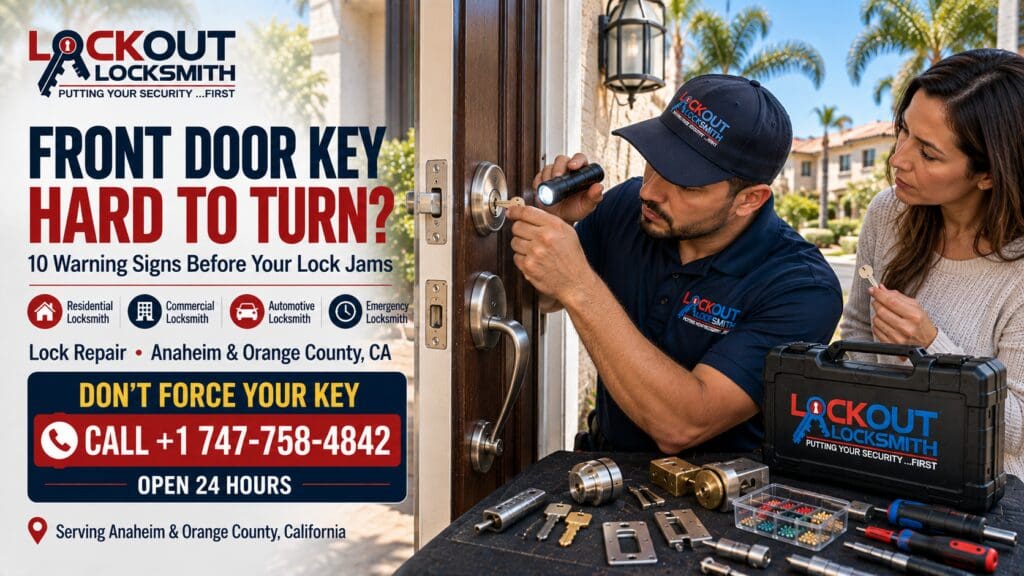
A front-door lock rarely gets your attention when it works properly.
You insert the key, turn it, open the door, and move on with your day.
That is why a small change can be easy to ignore.
Maybe your key now needs a slight wiggle before it turns. Perhaps you need to pull it back a fraction after inserting it. On some days the lock works normally, while on others the cylinder feels noticeably stiff.
Eventually, you may find yourself thinking:
“It still works, so I’ll deal with it later.”
For homeowners in Anaheim and throughout Orange County, California, that is not always the best approach.
A key becoming progressively harder to turn does not automatically mean the lock is about to fail. But a noticeable change in normal operation is worth investigating, particularly on a frequently used exterior door.
The issue could involve the key, cylinder, deadbolt mechanism, door position, strike alignment, mounting, or another part of the hardware.
The important thing is to avoid turning a manageable problem into a broken key, jammed lock, or inconvenient house lockout.
Here are 10 warning signs worth paying attention to.
1. Your Key Needs More Force Than It Used To
You know how your own front-door lock normally feels.
That familiarity matters.
If the same key suddenly requires noticeably more pressure to turn, something has changed.
A properly operating residential lock should not require you to grip the key tightly and force it through its rotation.
Before assuming the cylinder itself has failed, observe when the resistance occurs.
Does it happen while unlocking?
While locking?
With the door open?
Only after the door closes?
These differences can help a residential locksmith in Anaheim understand whether the issue appears to involve the keyed cylinder, deadbolt, or interaction between the door and frame.
Repeatedly applying additional force is not a long-term solution.
2. You Have to Wiggle the Key to Make It Work
A little movement during normal key insertion is one thing.
Having to perform the same increasingly complicated “key wiggle” every day is different.
For example, you may have learned to:
- insert the key fully;
- pull it back slightly;
- lift upward;
- turn halfway;
- reposition it;
- then try again.
If that routine is becoming necessary, pay attention.
The key or cylinder may no longer be operating as consistently as before.
A professional providing door lock repair in Anaheim can inspect both components rather than assuming the key alone is responsible.
Do not aggressively rake or shake the key inside the lock. That can place additional stress on the key and cylinder.
3. One Key Works Better Than Another
This is a particularly useful clue.
Suppose your household has two authorized keys for the same front door.
One works relatively smoothly.
The other requires considerable effort.
That difference may point toward the condition of the key rather than immediately proving that the entire lock is defective.
Compare them visually.
Is one noticeably more worn?
Bent?
Cracked?
Damaged near the shoulder?
Avoid continuing to use a key that is visibly compromised.
A locksmith in Anaheim, CA can evaluate the key and lock together and help determine whether the issue involves the key, cylinder, or both.
4. The Key Turns Easily When the Door Is Open
Here is a simple observation that can provide valuable information.
Open the front door.
Operate the lock normally.
If the key turns smoothly and the deadbolt extends and retracts without difficulty, remember that result.
Now close the door and operate the same lock.
Does it suddenly become much harder?
If so, the keyed cylinder may not be the only factor.
The deadbolt may be encountering resistance when interacting with the strike or frame.
A professional front door lock repair service in Anaheim can evaluate the complete entry system.
This distinction is important because replacing a perfectly functional cylinder would not necessarily correct a door-alignment problem.
5. You Have to Push or Pull the Door While Turning the Key
This habit often develops gradually.
At first, you push the door slightly.
A month later, you push harder.
Eventually, locking or unlocking becomes a two-handed operation.
One hand controls the door.
The other turns the key.
If pushing or pulling the door dramatically changes how easily the key operates, tell your locksmith.
That information can help distinguish a possible door/strike interaction from a problem that occurs regardless of door position.
A door lock repair technician in Anaheim should diagnose why the resistance exists instead of simply forcing the mechanism.
6. The Key Feels Rough During Rotation
Resistance does not always feel like one solid stop.
Sometimes the key feels rough, inconsistent, gritty, or uneven as it rotates.
Perhaps one section of the turn feels normal and another does not.
A change in tactile feedback is worth noticing.
Do not automatically assume that adding a random household lubricant will solve the problem.
Different lock manufacturers have different maintenance recommendations, and lubrication does not correct every mechanical issue.
If the problem is persistent or worsening, residential lock repair in Anaheim may be more appropriate than trial-and-error maintenance.
7. The Exterior Cylinder Moves While You Turn the Key
The key should move within the lock.
The entire lock assembly should not noticeably move with it.
Watch the exterior cylinder while operating the key normally.
Does the trim stay securely against the door?
Or does the cylinder shift, wobble, rotate, or pull away from the surface?
A loose lock assembly can affect operation and should not be ignored.
This is especially important when stiffness and physical movement occur together.
A mobile locksmith in Anaheim can inspect the mounting and operation of the installed hardware.
Depending on what is found, the solution may involve servicing the existing lock or considering replacement.
8. The Key Is Starting to Bend
This is one of the clearest reasons to stop applying more force.
A metal house key should not become your leverage tool.
If you notice that the blade is no longer straight, continuing to use it against a resistant lock can increase the risk of breakage.
A broken key inside a front-door cylinder creates an additional problem that may require extraction before the original lock issue can even be addressed.
If your key is visibly bent, cracked, or damaged, stop relying on it as your everyday key.
Have the lock inspected too.
A new key alone may not solve anything if excessive resistance from the lock caused the damage.
9. The Problem Is Worse From Outside Than Inside
If you have legitimate access to the inside through another entrance, compare the keyed operation with the interior thumb turn.
Does the thumb turn move the deadbolt smoothly?
Does the exterior key feel significantly harder?
That difference is useful diagnostic information.
For example, tell the technician:
“The inside thumb turn works normally, but the key outside has become difficult to rotate.”
That is more informative than saying:
“My deadbolt is bad.”
An experienced Anaheim residential locksmith can then evaluate the exterior cylinder and related mechanism in context.
10. The Problem Is Gradually Getting Worse
Progression matters.
A lock that feels slightly different once may not tell you much.
But a lock that becomes harder to operate week after week deserves attention.
Think about the progression:
Week 1: The key needs a small wiggle.
Week 2: You need to pull the door toward you.
Week 3: The key requires noticeably more pressure.
Week 4: You worry it may not turn at all.
That is the point where waiting for complete failure offers little advantage.
Scheduling lock repair in Anaheim while the door still operates can be more convenient than waiting until you are unable to enter or secure your home.
Why Is My House Key Suddenly Hard to Turn?
There is no single answer.
Several conditions can produce similar symptoms.
Possibilities can include:
- a worn or damaged key;
- cylinder wear;
- loose hardware;
- mechanical resistance;
- deadbolt binding;
- door and strike interaction;
- or another lock-related issue.
This is why diagnosis matters.
Replacing parts based solely on guesswork can result in spending money without correcting the actual problem.
A professional locksmith should evaluate what happens during normal operation and explain the recommended solution.
Key Hard to Turn Only When Locking the Door
Pay attention to direction.
If unlocking feels normal but locking becomes difficult, mention that.
Also compare operation with the door open and closed.
If the lock is smooth with the door open but becomes difficult when the door is closed, that distinction may point attention toward how the deadbolt interacts with the frame.
Do not automatically assume that the key cylinder needs replacement.
The complete system should be evaluated.
Key Hard to Turn Only When Unlocking
This is also useful information.
Does resistance appear only when retracting the deadbolt?
Does the door feel as though it is putting pressure on the bolt?
Does pushing or pulling the door change the resistance?
Does the interior thumb turn behave differently?
A professional deadbolt repair service in Anaheim can use these symptoms to better understand what is happening.
The objective is to identify the cause rather than simply overcome the resistance.
Can Hot Anaheim Weather Affect Door Locks?
Southern California’s environment can affect doors and hardware in different ways over time, but homeowners should be careful about blaming every lock problem on weather.
Anaheim can remain warm well into September.
Doors, frames, hardware, regular use, installation, wear, and building movement can all contribute to how an entry operates.
Instead of assuming:
“It’s just the heat.”
focus on the actual symptom.
If the lock has become consistently difficult to use, have the cause checked.
Should You Put Oil in a Stiff Door Lock?
Avoid treating every stiff lock with whatever lubricant happens to be in the garage.
First, determine what is actually resisting movement.
If the key turns smoothly when the door is open but becomes difficult when closed, lubricant is unlikely to correct the relationship between the deadbolt and strike.
If the cylinder itself feels rough, consult the lock manufacturer’s maintenance recommendations or a qualified locksmith.
The key point is simple:
Lubrication is maintenance—not a universal repair for every lock problem.
Should You Keep Using a Bent Key?
It is better not to.
A visibly bent key has already been subjected to stress.
Using it repeatedly in a stiff cylinder can increase the possibility of breakage.
If the key became bent because the lock requires excessive force, replacing only the key may leave the underlying problem unresolved.
Have both the key and lock evaluated.
Can a Hard-to-Turn Key Eventually Break?
It can.
Keys are not designed to be used as high-force handles.
Repeated twisting against significant resistance can stress the metal.
A key may also already have wear or damage that increases the risk.
If you feel that you need significantly more force than normal, stop before the key becomes stuck or breaks.
Professional lock repair near Anaheim may prevent a more inconvenient access problem.
Lock Repair vs. Lock Replacement
A stiff lock does not automatically need replacement.
Lock Repair
Residential lock repair in Anaheim may be appropriate when the existing hardware remains serviceable and the specific issue can reasonably be corrected.
Lock Replacement
Lock replacement in Anaheim may make more sense when the lock is significantly worn, damaged, unreliable, incompatible, or otherwise unsuitable for continued service.
If replacement is recommended, ask why.
You should understand what condition of the existing hardware makes replacement preferable.
Related service:
Should You Rekey a Hard-to-Turn Lock?
Rekeying serves a different purpose.
Lock rekeying in Anaheim changes which key operates compatible lock hardware.
It is commonly considered when:
- a house key is lost;
- you move into a new home;
- former occupants may have keys;
- authorized access changes;
- or you are uncertain who has copies.
A mechanical stiffness problem still needs to be diagnosed separately.
If you need both improved key control and mechanical service, tell the locksmith about both.
Related resource:
When Does a Stiff Lock Need a New Deadbolt?
That depends on what is causing the problem.
If the deadbolt itself is significantly worn or damaged, replacement may be appropriate.
But if the resistance comes from another condition, installing a new deadbolt without addressing that cause may not solve the issue.
A professional deadbolt installation in Anaheim should consider how the complete door operates.
Related information:
Is This a Good Time to Install a Smart Lock?
Maybe—if you actually want electronic access and the door is mechanically ready for it.
Do not install a smart lock simply because the current deadbolt is difficult to turn.
A motorized deadbolt still relies on physical bolt movement.
If the door creates significant resistance, the underlying mechanical condition should be corrected first.
After that, smart lock installation in Anaheim may be worth considering for features such as keyless entry or household access management.
Related resource:
What About a Keypad Door Lock?
The same principle applies.
A keypad door lock installation in Anaheim can provide convenient code-based access, but the door and lock preparation should operate properly.
Before upgrading, consider:
- door compatibility;
- mechanical operation;
- backup access;
- battery requirements;
- code management;
- and household needs.
Related information:
When Does a Hard-to-Turn Lock Become an Emergency?
A stiff key is not automatically an emergency.
But the situation becomes more urgent if:
- you cannot unlock an important exterior door;
- the key becomes stuck;
- the key breaks;
- the deadbolt cannot retract;
- the door cannot be secured;
- or you lose legitimate access to your home.
At that point, an emergency locksmith in Anaheim may be appropriate.
Lockout Locksmith lists its hours as Open 24 Hours.
Related resource:
What If the Lock Finally Jams and You Are Outside?
Do not turn a residential lock problem into a damaged-door problem.
Avoid kicking, prying, drilling, or attempting destructive entry.
If you have lost legitimate access because the lock will no longer operate, professional house lockout service in Anaheim may be appropriate.
Related resource:
Once access is restored, make sure the original cause of the stiff lock is diagnosed so the problem does not simply repeat.
A 60-Second Front Door Lock Check
You can learn a lot without dismantling anything.
Step 1 — Inspect the key
Look for obvious bending, cracking, or heavy wear.
Step 2 — Test with the door open
Use the key normally.
Step 3 — Observe the deadbolt
Does it extend and retract smoothly?
Step 4 — Close the door
Repeat normal operation.
Step 5 — Compare resistance
Is the key noticeably harder to turn?
Step 6 — Watch the cylinder
Does the lock itself wobble?
Step 7 — Test the interior thumb turn
Does it feel different?
Step 8 — Stop before forcing anything
If significant resistance persists, consider professional inspection.
Why September Is a Smart Time to Address Small Lock Problems
September in Anaheim and Orange County, California is still warm.
You do not need pumpkins, falling leaves, or cold weather to make seasonal home maintenance relevant.
Back-to-school routines are established. Summer trips are ending. Families are using their main entrances more consistently again.
That makes early fall a practical time to identify small entry problems.
A key that became slightly stiff during summer may be much more noticeable once the front door is being used repeatedly every morning and evening.
Addressing it now can help prevent an inconvenient lock failure later.
Choosing a Residential Locksmith in Anaheim
When requesting service, describe what is actually happening.
Useful examples include:
“My key turns normally with the door open but gets very stiff when the door is closed.”
“The outside key is difficult to turn, but the inside thumb turn works normally.”
“Both of my keys are becoming harder to turn.”
“The cylinder moves when I turn the key.”
These descriptions give a mobile locksmith in Anaheim more useful information than simply saying your lock is broken.
Depending on the diagnosis, appropriate services may include door lock repair, residential lock repair, deadbolt repair, lock replacement, rekeying, or new lock installation.
Need Lock Repair in Anaheim?
If your front-door key has become progressively harder to turn, requires repeated wiggling, works differently with the door closed, or is beginning to bend under normal use, consider having the hardware inspected before the lock becomes completely unusable.
Lockout Locksmith provides mobile residential, automotive, and emergency locksmith services throughout Anaheim and Orange County, California.
Depending on the situation, services may include door lock repair, residential lock repair, deadbolt repair, lock rekeying, lock changes, deadbolt installation, smart lock installation, keypad lock installation, house lockout assistance, and emergency locksmith service.
FAQ
Why is my front-door key suddenly hard to turn?
A worn key, cylinder issue, loose hardware, deadbolt resistance, or interaction between the door and strike may contribute. Comparing operation with the door open and closed can provide useful diagnostic information.
Why does my key turn easily when the door is open but not when it is closed?
If resistance appears only after the door closes, the deadbolt may be encountering resistance where it interacts with the strike or frame.
Should I force a key that is getting difficult to turn?
No. Excessive force can place additional stress on both the key and lock and may increase the risk of the key bending or breaking.
Can a locksmith repair a stiff door lock?
Depending on the cause and condition of the hardware, repair or adjustment may be possible. Significantly worn or damaged hardware may require replacement.
Does a hard-to-turn key mean I need a new lock?
Not necessarily. The cause should be diagnosed before deciding whether repair or replacement is appropriate.
Will rekeying fix a stiff lock?
Not necessarily. Rekeying changes which key operates compatible hardware. A mechanical resistance problem still requires diagnosis.
Can a bent house key break inside the lock?
Yes. A visibly bent or damaged key can be more vulnerable to breakage, especially if the lock requires excessive turning force.
When should I call an emergency locksmith?
If the lock no longer allows legitimate access, the key becomes stuck or breaks, or an important exterior door cannot be secured normally, urgent locksmith assistance may be appropriate.
Lockout Locksmith
Address: 1096 N Anaheim Blvd, Anaheim, CA 92801
Phone: +1 747-758-4842
Service Area: Anaheim & Orange County, California
Hours: Open 24 Hours
Serving Anaheim & Orange County, California: Lockout Locksmith provides mobile residential, automotive, and emergency locksmith services throughout Anaheim and Orange County, CA.
See Our Recent Customer Reviews
See our recent customer reviews on our Google Business Profile to learn about local customers’ experiences with Lockout Locksmith.