
Key Turns in the Front Door Lock but the Door Won’t Open in Anaheim, CA? Causes, Safe Fixes & Locksmith Solutions
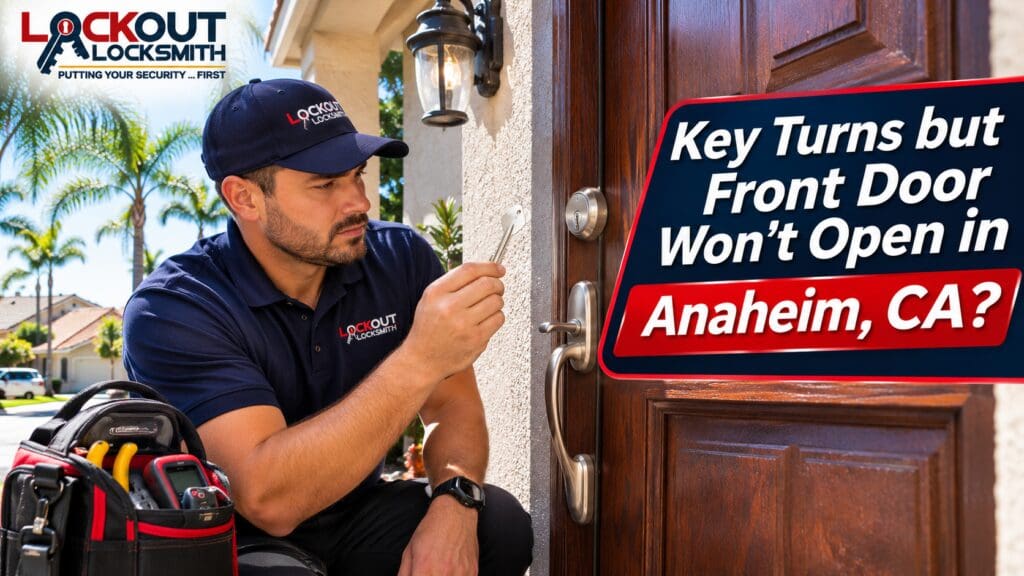
You get home after a long day, put your key into the front door, and turn it like you always do.
The key moves. You hear a small click. Everything seems normal.
But when you turn the handle and push the door, nothing happens.
You try again.
The key still turns, but the door refuses to open.
It’s the kind of problem that catches homeowners completely off guard. Your key isn’t missing, and it doesn’t appear to be broken. Yet you’re standing outside your own home, unable to get inside.
If your key turns but the door won’t open, the problem may not be the key at all. It could involve a stuck latch, a damaged deadbolt, a loose internal lock component, or a door that has shifted out of alignment.
In Anaheim, California, front door lock problems can affect older houses, newer residential properties, apartments, and rental homes alike.
The important thing is understanding what might be happening before trying to force the door.
This guide explains the common reasons a front door stays locked even when the key turns, safe troubleshooting steps, and when professional locksmith assistance is the best option.
Why Does My Key Turn but the Front Door Stay Locked?
A working door lock involves more than a key and a keyhole.
Depending on the hardware, the system may include a lock cylinder, internal cam, latch, deadbolt, strike plate, door handle, and connecting components.
When you turn the key, the cylinder operates part of the locking mechanism.
But that doesn’t guarantee every connected component is functioning correctly.
For example, the cylinder might rotate while an internal component fails to retract the deadbolt.
Or the lock may unlock successfully, but a damaged latch prevents the door from opening.
Sometimes the problem is caused by the door itself rather than the lock.
Common possibilities include:
- A jammed door latch
- A deadbolt that isn’t retracting completely
- A loose or damaged lock cylinder
- Worn internal lock components
- Door and strike plate misalignment
- A broken handle or spindle
- A door that has shifted or swollen
- Problems with a multipoint locking mechanism
- A previously installed lock that isn’t operating correctly
The exact cause depends on the door, lock type, and symptoms.
A professional residential locksmith in Anaheim, CA can inspect the hardware and determine whether repair, adjustment, rekeying, or replacement is appropriate.
1. The Door Latch May Be Stuck
One of the most common reasons a door won’t open is a latch that fails to retract.
The latch is the spring-loaded component that extends from the edge of the door into the strike plate.
When you turn the handle, the latch should move back into the door so it can swing open.
If the latch is damaged or jammed, the door may remain closed even after the lock is unlocked.
Signs of a Stuck Door Latch
You may notice:
- The key turns normally.
- The handle moves but the door stays closed.
- The handle feels loose or unusually stiff.
- The latch has been sticking for several days.
- The door opens only after repeated gentle attempts.
A stuck latch can develop from wear, internal damage, or misalignment.
If the latch doesn’t retract properly, replacing the key won’t solve the issue.
A technician offering door latch repair in Anaheim can inspect the latch assembly and determine whether it can be serviced or needs replacement.
2. The Deadbolt May Not Be Retracting Fully
Deadbolts provide an additional level of security because they use a solid bolt rather than a spring-loaded latch.
When you turn the key, the deadbolt should move fully into or out of the door.
But what happens if the key turns and the bolt only moves partway?
The door may remain secured.
Why Deadbolts Get Stuck
Possible causes include worn internal components, loose mounting hardware, mechanical damage, or pressure against the strike plate.
A deadbolt may also bind when the door has shifted out of alignment.
You might notice that the key turns farther than usual or that the lock feels inconsistent.
Avoid applying excessive twisting pressure.
If the mechanism is damaged, forcing the key can create additional problems.
Professional deadbolt repair in Anaheim, CA may involve inspecting the lock, checking alignment, and replacing damaged components when necessary.
For related information, see our Anaheim locksmith services.
3. The Lock Cylinder Could Be Turning Without Operating the Mechanism
Sometimes the key and cylinder appear to work, but the locking mechanism doesn’t respond.
This can happen when an internal connection becomes loose, worn, or damaged.
In some lock designs, the cylinder operates a cam or tailpiece that transfers movement to the lock mechanism.
If that connection fails, the key may rotate without moving the latch or bolt as intended.
What Does a Spinning Lock Cylinder Mean?
A cylinder that turns unusually far or spins without resistance may indicate an internal mechanical problem.
However, different lock designs have different operating ranges, so unusual movement should be evaluated in context.
Don’t keep rotating the key repeatedly.
A locksmith providing front door lock repair in Anaheim can determine whether the cylinder, tailpiece, or another internal component needs attention.
In some cases, the problem can be corrected without replacing the entire lockset.
In other situations, replacing the damaged assembly may be more reliable.
4. Door Misalignment Can Prevent the Lock From Releasing
A door doesn’t remain perfectly aligned forever.
Over time, hinges can loosen, hardware can wear, and the door frame can shift slightly.
Changes in temperature and moisture can also affect some door materials.
Even a small change in alignment can place pressure on the latch or deadbolt.
When the bolt presses against the strike plate, it may become difficult to retract.
Warning Signs of Door Misalignment
Look for symptoms such as:
- The door rubs against the frame.
- You have to lift the handle to close it.
- The deadbolt becomes harder to turn when the door is closed.
- The door closes more easily at certain times of day.
- The latch doesn’t line up smoothly with the strike plate.
If the lock works normally when the door is open but becomes difficult when closed, alignment is an important possibility.
A provider offering door lock adjustment in Anaheim may be able to identify the source of the binding.
Depending on the problem, hinge or door-frame repair may also be required.
5. A Damaged Strike Plate May Be Causing the Problem
The strike plate is the metal component mounted on the door frame where the latch or deadbolt enters.
Its position matters.
If the strike plate is loose, damaged, or incorrectly aligned, the locking mechanism may not operate smoothly.
A bolt can bind against the edge of the opening instead of moving freely.
Can a Strike Plate Be Repaired?
Sometimes the solution involves correcting alignment or replacing damaged hardware.
But the underlying cause should be identified first.
For example, repeatedly adjusting the strike plate won’t permanently solve a problem caused by loose hinges or a severely shifted door.
A professional door strike plate repair service can evaluate the relationship between the lock, door, and frame.
Proper alignment helps the door close securely and allows the locking mechanism to function as intended.
6. Your Door Handle Mechanism May Be Broken
The door handle and the key-operated lock don’t always control the same components.
On many residential doors, the key locks or unlocks the handle mechanism, while the handle retracts the latch.
If the handle’s internal spindle, spring, or connecting mechanism fails, the key may unlock the door without allowing the latch to retract.
Signs of Handle Failure
You may notice:
- The handle feels loose.
- The handle moves without retracting the latch.
- The handle doesn’t return to its normal position.
- The door opens inconsistently.
- The problem has gradually become worse.
A damaged handle assembly may require repair or replacement.
If you need residential door handle replacement in Anaheim, choose hardware compatible with your door’s existing preparation and security requirements.
Replacing only the key cylinder won’t fix a broken handle mechanism.
7. A Multipoint Locking System Could Be Jammed
Some residential doors use multipoint locking systems.
These mechanisms secure the door at several points along its edge rather than relying on a single latch or deadbolt.
They are commonly associated with certain patio, entry, and specialty doors.
When one part of the mechanism becomes misaligned or damaged, the entire system may be difficult to operate.
A key may turn while the door remains secured at another locking point.
Why Multipoint Locks Need Careful Diagnosis
These systems contain interconnected components.
Attempting to force the handle or key can damage additional parts.
A locksmith familiar with the specific hardware may be able to determine whether adjustment, repair, or replacement is appropriate.
Some multipoint lock repairs also require specialized parts that aren’t interchangeable with standard residential deadbolts.
8. A Recently Installed Lock May Have an Installation Problem
Did the problem begin shortly after a new lock was installed?
If so, installation deserves consideration.
A lock that isn’t positioned correctly may bind during operation.
Mounting screws, internal components, or the alignment between the lock and strike plate can affect performance.
For example, a deadbolt might operate normally while the door is open but become difficult to turn when the door is closed.
What Should You Do?
Avoid loosening or removing security hardware while you’re locked outside.
If the lock was recently installed, contact the installer and explain the symptoms.
A professional lock installation service in Anaheim can inspect the setup and determine whether adjustment or replacement is needed.
Proper installation is important for both convenience and security.
9. Can a Worn Key Cause the Door to Stay Locked?
Yes, but not every situation involves key wear.
A worn key may fail to align the internal cylinder components consistently.
Sometimes the key turns only partway or requires extra movement.
However, if the key rotates normally and the locking mechanism doesn’t respond, the problem may be deeper inside the hardware.
Should You Make a Duplicate Key?
Duplicating a heavily worn key isn’t always the best solution.
The duplicate may reproduce the same wear-related inaccuracies.
A locksmith can evaluate whether a correctly cut replacement key is needed.
If the lock cylinder itself is damaged, a new key may not solve the problem.
Professional house key replacement in Anaheim should begin with identifying whether the key or lock is responsible.
10. Weather and Door Material Changes Can Affect Lock Operation
Anaheim generally experiences mild weather, but doors can still respond to environmental conditions.
Wooden doors may expand or contract as moisture levels change.
Other materials can experience thermal movement, while hinges and frames may shift over time.
These changes can affect how the latch or deadbolt aligns with the strike plate.
A door that operated smoothly in the past may begin rubbing or binding.
When Is Weather-Related Binding More Likely?
You might notice that the door becomes harder to operate after rain, during temperature changes, or when humidity is higher.
However, weather isn’t always the primary cause.
Existing hinge wear, poor installation, or frame movement may contribute.
If the problem keeps returning, arrange an inspection instead of relying on repeated force.
Safe Things to Try When Your Key Turns but the Door Won’t Open
Being locked outside your home is stressful.
Before attempting anything, consider whether there’s an immediate safety issue.
If someone inside needs urgent medical assistance, there’s a fire, or another emergency exists, contact emergency services.
For a nonemergency lock problem, the following cautious steps may help you understand the situation.
Step 1: Stop Forcing the Key
If the key turns but the door doesn’t open, avoid twisting harder.
Excessive pressure can bend or break the key or damage the lock cylinder.
Step 2: Check Whether the Handle Operates Normally
Notice whether the handle feels loose, unusually stiff, or disconnected.
Don’t force it beyond its normal range.
Step 3: Try Gentle Door Pressure
If the door appears to be binding against the frame, a small amount of normal opening or closing pressure may relieve tension while operating the lock.
Stop immediately if significant force is required.
Step 4: Use Another Authorized Entrance
If you have a safe, accessible alternative entrance and are authorized to use it, that may be the simplest option.
Avoid climbing, breaking windows, or attempting unsafe entry methods.
Step 5: Contact a Professional Locksmith
If the door remains stuck, request assistance from a qualified emergency house lockout locksmith in Anaheim.
Explain that the key turns but the door won’t open.
That distinction can help the technician prepare for a possible mechanical lock or latch issue.
Can a Locksmith Open the Door Without Replacing the Lock?
In many situations, a locksmith can assess the lock and attempt an appropriate non-destructive solution.
However, whether the door can be opened without replacing hardware depends on the condition of the mechanism.
For example, a door with alignment-related binding may require a different approach from one with a broken internal latch.
A severely damaged lock may need replacement.
A professional house lockout service in Anaheim should explain the available options and any likely additional work.
Proof of residency or authorization may be requested before access is provided.
For related assistance, read our emergency locksmith guide for Anaheim.
Should You Repair, Rekey, or Replace the Lock?
These services solve different problems.
Lock repair addresses damaged or malfunctioning hardware.
Rekeying changes the key combination of a compatible lock cylinder without necessarily replacing the entire lock.
Lock replacement involves installing new hardware.
If the key turns but the door won’t open because of a broken latch or deadbolt mechanism, rekeying alone generally won’t correct the mechanical failure.
| Problem | Potential Solution |
|---|---|
| Stuck latch | Latch inspection and repair |
| Deadbolt binding | Alignment correction or repair |
| Broken internal mechanism | Component or lock replacement |
| Worn key | Correctly cut replacement |
| Door misalignment | Hinge, strike plate, or door adjustment |
| Lost key security concerns | Rekeying or lock replacement |
| Damaged multipoint mechanism | Specialized repair or replacement |
For additional guidance, see our rekey or replace locks guide.
How Much Does Front Door Lock Repair Cost in Anaheim?
The cost depends on what has failed.
A simple adjustment may involve different labor and materials than replacing a damaged multipoint locking system.
Factors that influence pricing include:
- Lock type and manufacturer
- Condition of the latch or deadbolt
- Whether the door is currently locked shut
- Parts availability
- Door and frame condition
- Labor requirements
- Emergency or after-hours service
- Whether new hardware is necessary
When contacting an emergency locksmith near me in Anaheim, ask about the service call charge, diagnostic fees, labor, replacement parts, and any after-hours charges.
An accurate estimate may require an on-site inspection.
Avoid assuming that every lock problem can be repaired for one advertised starting price.
How to Prevent Your Front Door Lock From Failing Again
A few preventative habits can reduce the risk of unexpected lock problems.
Address Sticking Early
If the key, latch, or handle begins operating differently, investigate before the door becomes impossible to open.
Check Door Alignment
A door that rubs against the frame or requires extra pressure may need adjustment.
Avoid Excessive Force
Keys and lock mechanisms are designed for normal operation, not aggressive twisting.
Use Compatible Hardware
When replacing a lock, choose components suitable for the door and its existing preparation.
Maintain the Door and Hinges
Loose hinges and damaged frames can affect locking performance.
Schedule Professional Inspection When Needed
A qualified home locksmith in Anaheim can help identify mechanical lock problems before they become more serious.
Residential Locksmith Services in Anaheim and Nearby Cities
Lockout Locksmith provides residential locksmith services in Anaheim and surrounding communities.
Relevant service areas include:
- Anaheim Locksmith Services
- Fullerton Locksmith Services
- Orange Locksmith Services
- Placentia Locksmith Services
- Buena Park Locksmith Services
- Garden Grove Locksmith Services
Call to confirm current technician availability for your location and lock type.
Frequently Asked Questions
1. Why does my key turn but my front door won’t open?
The problem may involve a stuck latch, binding deadbolt, damaged internal lock component, broken handle mechanism, or door misalignment. A professional inspection can identify the cause.
2. Can a locksmith fix a door lock that turns but won’t open?
Yes, depending on the hardware and condition. A locksmith may be able to repair or replace the affected mechanism or recommend door alignment work.
3. Does a turning key mean the lock cylinder is working correctly?
Not necessarily. The cylinder may rotate while an internal connection fails to operate the latch or deadbolt.
4. Should I force the door open if the key turns?
No. Excessive force can damage the lock, door, or frame and may cause injury. Stop if normal operation doesn’t release the door.
5. Will rekeying fix a door that won’t open?
Usually not if the problem involves a broken latch, damaged deadbolt, or misaligned door. Rekeying changes the cylinder’s key combination rather than repairing unrelated mechanical faults.
6. How much does front door lock repair cost in Anaheim?
Pricing depends on the lock type, damage, parts, labor, and whether emergency service is needed. Contact Lockout Locksmith for service information and an estimate.
7. Can a locksmith open my front door without damaging it?
Non-destructive access may be possible, but it depends on the lock’s condition and the cause of the failure. Some damaged mechanisms require additional repair or replacement.
8. Is emergency residential locksmith service available in Anaheim?
Lockout Locksmith advertises 24-hour locksmith services in Anaheim. Call +1 (747) 758-4842 to confirm current availability.
Need Help With a Front Door That Won’t Open in Anaheim?
A key that turns without opening the door can indicate a problem with the latch, deadbolt, cylinder, handle, or door alignment.
Continuing to force the hardware may make the problem worse.
Whether you’re locked outside your home or dealing with a front door that has become increasingly difficult to operate, identifying the cause is the first step toward a reliable repair.
Lockout Locksmith provides residential locksmith assistance in Anaheim and nearby Orange County communities.
Business Name: Lockout Locksmith
Address: 1096 N Anaheim Blvd, Anaheim, CA 92801
Phone: +1 (747) 758-4842
Hours: Open 24 Hours
Website: https://lockoutlocksmithservices.com/
Google Maps: https://www.google.com/maps/place/?cid=3484008992119144057
Call +1 (747) 758-4842 to discuss your front door lock problem and request residential locksmith assistance in Anaheim, California.