
Key Won’t Come Out of Your Door Lock? 8 Reasons Anaheim Homeowners Should Act Before It Breaks
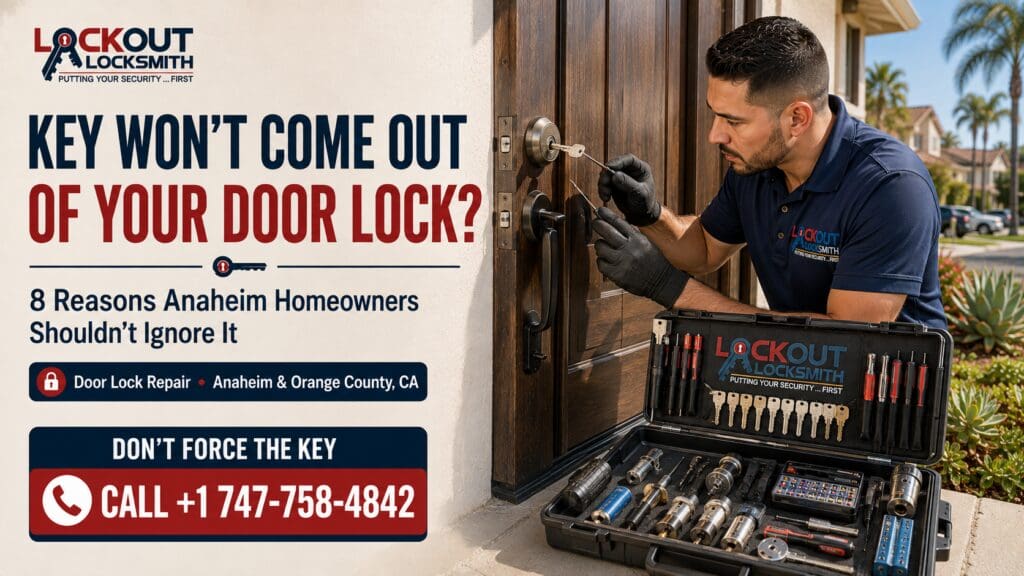
You arrive home, unlock the front door, and turn the handle as usual. The door opens—but when you try to pull the key out, it stays in the lock.
You wiggle it gently.
Nothing.
You turn it slightly in the other direction. It moves, but the key still won’t come out.
At that moment, it’s tempting to use more force. After all, the key went into the lock normally, so pulling harder seems like the obvious solution.
Unfortunately, that’s also how a relatively manageable lock problem can turn into a broken key stuck inside the cylinder.
For homeowners in Anaheim and throughout Orange County, California, a key that suddenly becomes difficult to remove deserves attention. Sometimes the cause is as simple as the key not returning completely to its removal position. In other cases, the key may be worn, the cylinder may be binding, the lock may be loose, or pressure from the door may be affecting the mechanism.
The important thing is not to panic—and not to force it.
If you’re dealing with a key stuck in a door lock in Anaheim, understanding why it happened can help you decide whether the lock needs a simple adjustment, professional door lock repair, rekeying, or replacement.
Here are eight common reasons a house key may become stuck in a residential door lock.
1. The Key Hasn’t Returned to the Correct Removal Position
Before assuming something inside the lock has failed, pay attention to the position of the key.
Most keyed residential cylinders require the key to return to a particular orientation before it can be removed.
If you’ve turned the key to unlock the door but haven’t fully returned it to its normal removal position, it may remain captured by the cylinder.
This can happen easily when you’re in a hurry.
Try returning the key gently toward its normal position without bending or twisting it sideways.
The keyword here is gently.
If you encounter unusual resistance, stop.
Repeatedly twisting a key against resistance can damage the key or internal components.
If the key regularly refuses to return to its normal position, the issue may be more than simple user positioning. A residential locksmith in Anaheim can inspect the cylinder and determine why the mechanism isn’t operating smoothly.
2. Your House Key May Be Worn or Bent
Keys are small pieces of metal that go through thousands of operating cycles.
They don’t remain perfect forever.
Take a close look at the key if you’re able to remove it.
You may notice:
- rounded or heavily worn cuts;
- a slight bend along the blade;
- cracks near the shoulder;
- damaged edges;
- or visible twisting.
A key doesn’t need to look dramatically damaged to create problems.
Even a small bend can affect how it moves through the internal components of a cylinder.
This becomes especially important when the lock itself is already stiff.
A homeowner may unconsciously compensate by pushing, pulling, or twisting the key harder each time the door is used.
Eventually, the key may become difficult to remove.
And if enough force is applied, it can break.
If your key is visibly damaged, don’t continue using it simply because it still works occasionally.
Have both the key and the lock evaluated.
A new key alone may not solve the problem if the cylinder or door alignment is contributing to the resistance.
3. The Lock Cylinder May Be Worn
The cylinder is the part of the lock where you insert your key.
Inside it are components that must interact correctly with the cuts on the key.
Over time, those components can wear.
A worn cylinder may not fail all at once.
Instead, you may notice gradual symptoms.
For example:
- the key doesn’t insert as smoothly as before;
- you need to jiggle the key;
- turning becomes inconsistent;
- the key sometimes feels trapped;
- or removing it requires finding a very specific angle.
Those are useful warning signs.
If the problem is becoming more frequent, a professional door lock repair service in Anaheim can inspect the cylinder before the key becomes completely stuck or breaks.
Depending on the condition and type of hardware, the appropriate solution might involve repair, servicing, rekeying, or replacement.
Don’t assume every cylinder problem automatically requires a new lock.
But don’t ignore a cylinder that is clearly becoming unreliable either.
4. The Lock Cylinder Itself May Be Loose
When removing the key, pay attention to whether the cylinder or exterior lock trim moves with it.
The lock should not feel as though it’s coming out of the door with your key.
Loose mounting hardware can allow parts of the lock assembly to shift.
That movement can interfere with normal key operation.
You may notice:
- the exterior cylinder rotating slightly;
- trim moving against the door;
- the interior thumb turn feeling loose;
- the handle set wobbling;
- or the entire lock assembly shifting.
A loose lock isn’t something you should keep compensating for by holding it in place while pulling the key out.
Have the hardware inspected.
A lock repair locksmith in Anaheim can determine whether the problem involves mounting hardware, the cylinder, another component, or a combination of issues.
5. Door Alignment May Be Putting Pressure on the Lock
This is one of the reasons homeowners sometimes replace a lock and then discover the new one doesn’t operate as smoothly as expected.
The lock may not be the only problem.
Your door, hinges, frame, weather stripping, strike plate, and deadbolt all interact.
If the door isn’t sitting properly in the frame, pressure can transfer to the locking mechanism.
Here’s a useful observation.
If possible, compare how the lock operates with the door open versus closed.
Does the key turn and come out normally when the door is open?
But once the door is closed, does it become difficult?
If so, alignment may be contributing to the problem.
You may also notice that the lock behaves differently when you:
- push the door inward;
- pull it toward you;
- lift slightly on the handle;
- or relieve pressure from the door.
These are clues—not permanent solutions.
A properly functioning exterior lock shouldn’t require a complicated routine every time you use it.
If you’re searching for lock repair near me in Anaheim, describe these symptoms when requesting service. They can help distinguish a cylinder problem from a broader door-and-hardware issue.
6. The Deadbolt Mechanism May Be Binding
Sometimes the key cylinder isn’t the only component creating resistance.
The deadbolt itself may not be moving smoothly.
Pay attention to the interior thumb turn.
Does it also feel unusually difficult?
Does the bolt hesitate?
Does it stop before fully retracting?
Does it operate normally when the door is open but bind when the door is closed?
If both interior and exterior operation feel stiff, the bolt mechanism or alignment deserves attention.
This is especially important because repeatedly forcing the exterior key puts stress on a much smaller piece of metal.
If the deadbolt hardware is damaged, significantly worn, or unsuitable, deadbolt replacement or deadbolt installation in Anaheim may eventually be appropriate.
However, don’t replace the deadbolt before identifying the actual cause.
If strike alignment is responsible, simply installing another deadbolt may not correct the underlying issue.
For related service information, see Deadbolt Installation Near Me:
7. Dirt, Wear, or Internal Resistance May Be Affecting the Cylinder
Residential locks are exposed to everyday environmental conditions.
Exterior cylinders encounter dust, debris, moisture, temperature changes, and years of repeated use.
Over time, operation can become less smooth.
However, that doesn’t mean you should pour whatever household lubricant happens to be nearby into the keyway.
Different lock manufacturers and lock types may have specific maintenance recommendations.
Using an unsuitable product can sometimes create additional problems or attract debris.
If your lock has become consistently difficult, check the manufacturer’s maintenance guidance for the specific hardware or have it professionally inspected.
This is particularly important when the symptoms are getting worse rather than remaining occasional.
A mobile locksmith in Anaheim can examine the installed hardware and determine whether the issue involves maintenance, wear, alignment, or actual component failure.
8. The Key or Lock May Be Close to Failing
Sometimes a stuck key is not an isolated event.
It’s the latest warning in a pattern.
Think back over the last few weeks or months.
Has the lock gradually become harder to use?
Have you started jiggling the key?
Do you need to pull the door before turning it?
Does the cylinder feel loose?
Has the key started looking bent?
Does another authorized key behave differently?
If several of these symptoms are happening together, continuing to use the lock without addressing the cause increases the chance of a complete failure at an inconvenient time.
That’s when a small residential lock problem can become a house lockout in Anaheim.
Instead of waiting until the key snaps or the lock stops opening, consider having the hardware inspected while you still have normal access to the property.
What Should You Do Right Now If the Key Is Stuck?
If your house key is currently stuck in the lock, the first priority is avoiding unnecessary damage.
Don’t yank the key straight out
More force isn’t necessarily better.
If internal components are holding the key, aggressive pulling can bend or break it.
Don’t repeatedly twist it against heavy resistance
A key is designed to operate a lock, not function as a lever.
If it clearly doesn’t want to turn, stop increasing pressure.
Check the key position
Make sure the key has gently returned to its normal removal orientation.
Relieve obvious door pressure
If the door is closed and you already know it tends to bind, gentle pressure on the door may change the load on the lock.
Don’t force the door or hardware.
Don’t insert random objects into the keyway
Trying to pry or manipulate the key with improvised tools can damage the cylinder or push the problem farther inside.
If the key remains stuck, call for professional help
A locksmith in Anaheim, CA can inspect the problem and determine whether the key can be removed without unnecessarily damaging otherwise serviceable hardware.
This is particularly important if the key is already bent or appears close to breaking.
What If the Key Breaks Inside the Door Lock?
If part of the key breaks inside the cylinder, the situation changes.
Don’t keep pushing on the remaining fragment.
Don’t insert another key behind it.
And avoid improvised extraction methods that may drive the broken blade deeper into the cylinder.
A professional broken key extraction service in Anaheim may be able to remove the fragment depending on its position and the condition of the lock.
But extraction is only half the question.
You also need to ask:
Why did the key break?
If the key was already damaged, that may explain it.
But if the lock had been sticking, binding, or requiring excessive force, the cylinder or door hardware should also be inspected.
Otherwise, removing the broken key without addressing the cause may simply set up the same problem for the replacement key.
Don’t Wait Until a Stuck Key Becomes a Lockout
A key that occasionally sticks may seem like a small annoyance.
But if it keeps happening, the lock is giving you useful information.
Something isn’t operating the way it should.
The easiest time to investigate is usually before you’re standing outside with half a key in your hand.
For homeowners in Anaheim and Orange County, California, early inspection can help determine whether the problem involves the key, cylinder, deadbolt, mounting hardware, door alignment, or another issue.
And importantly, finding a problem doesn’t automatically mean you need a completely new lock.
The correct solution depends on what is actually wrong.
Should You Repair, Rekey, or Replace a Lock After a Key Gets Stuck?
Once the key is safely removed, there’s an important question:
What should you do with the lock?
The answer isn’t automatically “replace it.”
A stuck key can be caused by several different problems, which means the appropriate service depends on what the inspection reveals.
Here’s how the three common options differ.
Lock Repair
Door lock repair in Anaheim may be appropriate when the existing hardware is still suitable but something is preventing it from operating correctly.
Depending on the lock and the actual problem, a locksmith may inspect the cylinder, mounting hardware, deadbolt mechanism, strike alignment, and the condition of the key.
This is why diagnosing the cause matters.
If the cylinder is fine but the door is placing pressure on the deadbolt, replacing the cylinder alone may not solve the problem.
Likewise, if the key itself is badly worn, the lock shouldn’t automatically be blamed without further inspection.
A professional residential locksmith in Anaheim should be looking at how the entire door-and-lock system operates.
When Does Rekeying Make Sense?
Rekeying solves a different problem.
A lock rekey service in Anaheim changes which key operates compatible existing hardware.
For example, rekeying may be useful when the lock itself remains serviceable but you want an old or missing key to stop working.
That could happen after:
- losing a house key;
- moving into a home;
- changing authorized access;
- or discovering that an old key is unaccounted for.
However, rekeying should not be confused with mechanical repair.
If your cylinder is physically damaged or the deadbolt is binding because of door alignment, simply changing the keying doesn’t necessarily correct that problem.
If the key became stuck because the lock is mechanically failing, address that issue first.
For more information, see:
When Is Lock Replacement the Better Option?
Sometimes keeping the existing hardware doesn’t make practical sense.
Lock replacement in Anaheim may be worth considering when the lock is:
- physically damaged;
- badly worn;
- repeatedly malfunctioning;
- missing important components;
- unreliable despite appropriate service;
- or no longer suitable for how you want to use the door.
Replacement may also make sense when you’re intentionally upgrading the entrance.
For example, perhaps the key sticking problem finally convinced you to replace an aging deadbolt that has caused trouble for years.
That’s different from replacing a perfectly functional lock simply because the key got stuck once.
A professional locksmith in Anaheim, CA should be able to explain why replacement is being recommended.
For related information:
What If the Key Gets Stuck in a Brand-New Lock?
A new lock shouldn’t automatically be assumed defective.
If a recently installed lock is difficult to operate, several factors may need to be checked.
The hardware itself could have an issue, but installation or door alignment may also be involved.
Ask:
Does the key operate smoothly when the door is open?
Does the problem only occur after the door is closed?
Does the bolt enter the strike freely?
Does the interior thumb turn also feel difficult?
Does the hardware sit securely against the door?
If a new deadbolt is fighting against the door frame every time it operates, the installation or alignment should be inspected.
This is particularly important before replacing the new lock with another one.
Can a Smart Lock Solve a Sticking-Key Problem?
Maybe—but don’t treat a smart lock as a repair.
A smart lock installation in Anaheim can change the way you access your home, depending on the hardware and features selected.
But underneath the electronic functions, many smart locks still rely on a mechanical deadbolt moving correctly.
If the bolt binds against the strike, an electronic motor may encounter the same physical resistance your hand did.
Before installing a smart lock, make sure:
- the door closes correctly;
- the bolt extends and retracts smoothly;
- the strike is appropriately aligned;
- the door hardware is suitable;
- and the chosen smart lock is compatible with the door.
If the physical door isn’t operating properly, correct that issue first.
Related service:
Smart Lock Installation Near Me
Would a Keypad Lock Prevent This Problem?
A keypad lock can reduce how often you rely on a physical key for everyday entry.
That can be convenient.
However, some keypad locks still include a physical key cylinder as a backup or alternative access method.
So installing a keypad doesn’t mean mechanical lock maintenance becomes irrelevant.
If you’re considering keypad door lock installation in Anaheim, choose a model based on your actual access needs rather than simply trying to escape a current lock problem.
Consider:
- how authorized codes are managed;
- whether temporary codes are needed;
- battery requirements;
- backup-access methods;
- hardware compatibility;
- and how the lock behaves during normal mechanical operation.
Related service:
Keypad Door Lock Installation Near Me
When Does a Stuck Key Become an Emergency?
A key that sticks occasionally isn’t automatically an emergency.
If you’re safely inside your home, the door can be secured, and another entrance remains legitimately available, you may be able to schedule normal service.
But some situations are more urgent.
You may need an emergency locksmith in Anaheim when:
- you’re locked outside your home;
- the key has broken inside the only usable entrance;
- the lock will not open;
- an important exterior door cannot be secured;
- the cylinder has failed;
- or the lock problem prevents normal authorized access.
If you call an emergency locksmith, explain exactly what’s happening.
For example:
“My house key is stuck in the front-door deadbolt. The key won’t come out, and the door won’t unlock.”
That description is much more useful than simply saying:
“My lock is broken.”
For related assistance:
What If the Key Breaks and You’re Locked Outside?
This combines two problems:
- a broken key; and
- a residential lockout.
Avoid aggressive attempts to force entry.
Improvised methods can damage the lock, door, trim, or frame and may turn a relatively contained problem into a larger repair.
A professional house lockout service in Anaheim can assess legitimate access options.
Once you’re back inside, don’t stop at solving the lockout if the lock contributed to the problem.
If the key broke because the cylinder had been increasingly difficult to operate, have that issue inspected as well.
Otherwise, the next key may encounter the same resistance.
Related page:
Can a Mobile Locksmith Handle the Problem at Your Home?
Yes. Residential lock problems are commonly evaluated at the property.
A mobile locksmith in Anaheim can see the lock exactly as it operates in the installed door.
That’s valuable because the technician can inspect more than the cylinder.
The service visit may allow evaluation of the:
- key;
- cylinder;
- deadbolt;
- handle or lever;
- mounting hardware;
- strike;
- door position;
- and relevant alignment.
This is one advantage of diagnosing the lock where the problem actually occurs.
A cylinder that appears normal on its own may behave differently when the door and deadbolt are under pressure.
How Can You Reduce the Chance of a Key Getting Stuck Again?
No lock lasts forever, and no maintenance routine can guarantee that hardware will never fail.
Still, paying attention to early warning signs can help.
1. Stop forcing difficult locks
If a key requires increasing force, don’t normalize it.
Repeated force can damage the key and may make an existing problem worse.
2. Replace visibly damaged keys
A bent or cracked key isn’t worth continuing to use.
If you replace the key but the new one also struggles, have the lock inspected.
3. Pay attention to changes
A lock that suddenly feels different deserves attention.
You use your front door often enough to know what “normal” feels like.
4. Check for loose hardware
If the cylinder, handle, or trim moves noticeably, don’t ignore it.
5. Notice door alignment
If the lock works with the door open but not closed, tell the locksmith.
That’s useful diagnostic information.
6. Don’t use random products inside the lock
Follow the lock manufacturer’s maintenance guidance rather than automatically applying whatever lubricant is available.
7. Address recurring problems early
A lock that sticks once may be an isolated event.
A lock that sticks every day is telling you something.
Should You Replace All Your Locks Because One Key Got Stuck?
Usually, no.
A problem with one lock doesn’t automatically mean every lock around the property needs replacement.
Inspect the affected hardware first.
If other locks are operating normally and meet your needs, there may be no reason to change them.
However, if several locks are the same age and showing similar symptoms, you may choose to have them inspected during the same service visit.
That can be particularly useful if you’re already scheduling a residential locksmith in Anaheim.
The goal should be appropriate service—not unnecessary hardware replacement.
What Should You Tell the Locksmith When You Call?
You don’t need to understand lock terminology.
Simply describe the symptoms.
Useful details include:
- whether the key is currently stuck;
- whether the door is locked or unlocked;
- whether you’re inside or outside;
- whether the key is bent;
- whether part of the key has broken;
- whether the cylinder moves;
- whether the lock works when the door is open;
- whether the interior thumb turn works;
- and how long the problem has been happening.
Also mention your location in Anaheim or elsewhere in Orange County.
These details help clarify whether you’re requesting scheduled door lock repair in Anaheim or more urgent lockout assistance.
A Stuck Key Is Often a Warning, Not Just an Annoyance
It’s easy to think:
“I got the key out, so the problem is solved.”
Maybe.
If it happened because the key simply wasn’t returned to its correct position, you may have nothing more to deal with.
But if the same key repeatedly becomes trapped, the lock becomes harder to turn, the cylinder moves, or the door must be pushed or pulled to operate the deadbolt, don’t ignore the pattern.
Your lock is one of those household items that works quietly until the moment it doesn’t.
A five-minute inspection while the door still works can be much more convenient than dealing with a broken key and a lockout later.
Need Help With a Key Stuck in a Door Lock in Anaheim?
If your house key is stuck, your deadbolt is becoming difficult to operate, or you’re concerned that the key may break, Lockout Locksmith provides mobile locksmith services throughout Anaheim and Orange County, California.
Depending on the condition of the hardware and the specific situation, services may include door lock repair, residential lock rekeying, lock changes, deadbolt installation, smart lock installation, keypad lock installation, broken-key assistance, house lockout service, and emergency locksmith assistance.
Frequently Asked Questions
Why won’t my key come out of my door lock?
Possible causes include the key not being fully returned to its removal position, a bent or worn key, cylinder wear, loose hardware, deadbolt resistance, or door alignment. Persistent problems should be inspected.
Should I pull harder if my house key is stuck?
No. Excessive pulling or twisting can bend or break the key. If gentle repositioning doesn’t release it, stop applying additional force and consider professional assistance.
Can a locksmith remove a stuck key without replacing the lock?
Depending on the condition of the key and lock, it may be possible to remove the key without replacing otherwise serviceable hardware. The locksmith should inspect the lock afterward to determine why the key became stuck.
Does a stuck key mean I need a new lock?
Not necessarily. The cause could involve the key, cylinder, mounting hardware, deadbolt, or door alignment. Replacement is generally more relevant when hardware is damaged, badly worn, unreliable, or unsuitable.
Should I rekey a lock after a key gets stuck?
Not automatically. Rekeying changes which key operates compatible hardware. It isn’t inherently a repair for a mechanical sticking problem.
What should I do if my key breaks inside the lock?
Avoid pushing the broken fragment farther into the cylinder or inserting another key behind it. Professional extraction may be appropriate, and the underlying reason the key broke should also be investigated.
Why does my key only stick when the door is closed?
That can suggest pressure or alignment involving the door, deadbolt, and strike. If the lock works normally with the door open but becomes difficult when closed, mention that symptom during inspection.
Is a key stuck in a door lock an emergency?
Not always. It becomes more urgent when you cannot access your home, cannot secure an important exterior door, the key breaks, or the locking mechanism fails.
Can a mobile locksmith come to my Anaheim home?
Yes. Mobile residential locksmith services can be performed at the property, allowing the installed lock, door, deadbolt, strike, and related hardware to be evaluated together.
Lockout Locksmith
Address: 1096 N Anaheim Blvd, Anaheim, CA 92801
Phone: +1 747-758-4842
Service Area: Anaheim & Orange County, California
Hours: Open 24 Hours
Serving Anaheim & Orange County, California: Lockout Locksmith provides mobile residential, automotive, and emergency locksmith services throughout Anaheim and Orange County, CA.
See Our Recent Customer Reviews: Visit our Google Business Profile to see recent customer reviews and learn what local customers say about their experience with Lockout Locksmith.