
Front Door Won’t Lock Unless You Push or Pull It? 10 Reasons Anaheim Homeowners Should Fix It Before Fall
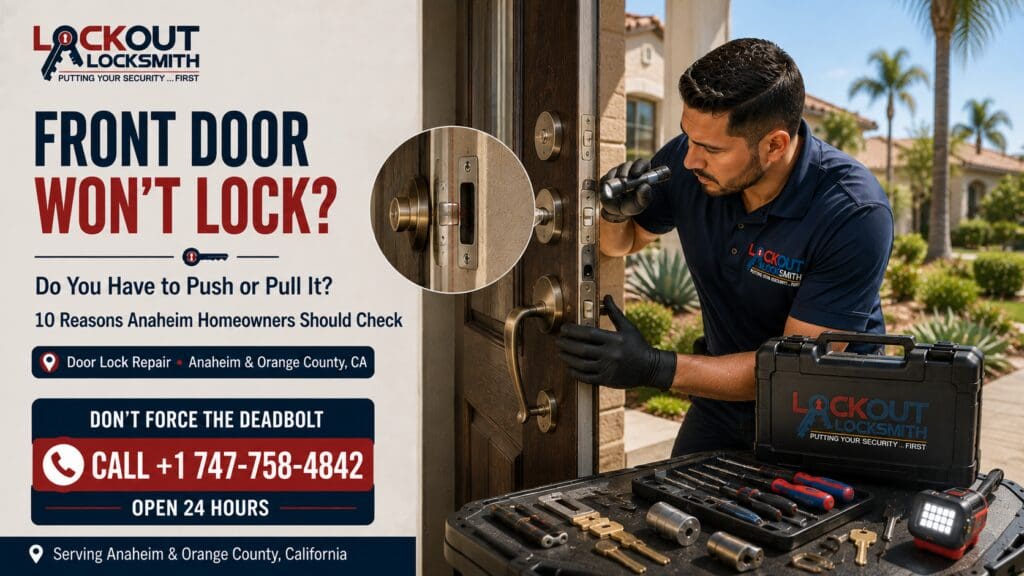
You close your front door, turn the deadbolt, and it stops halfway.
So you pull the door toward you.
Click.
The deadbolt suddenly slides into place.
Maybe you’ve been doing this for months without thinking about it. Perhaps everyone in the family already knows the routine: close the door, lift the handle slightly, pull it toward the frame, then turn the lock.
If that sounds familiar, your lock is technically working—but the complete door-and-lock system probably isn’t operating the way it should.
A residential deadbolt should generally extend and retract without requiring you to force the door into a special position every time.
For homeowners in Anaheim and throughout Orange County, California, a front door that only locks while being pushed, pulled, lifted, or leaned against can point to several possible issues. The deadbolt itself may be involved, but so can the strike, hinges, door position, weather stripping, mounting hardware, or frame.
Before fall routines get busier, here are ten reasons this problem deserves a closer look.
1. The Deadbolt and Strike May No Longer Line Up
Start with the relationship between the deadbolt and the opening in the frame.
When the door closes, the bolt needs to enter its receiving area without fighting the surrounding hardware.
If the alignment has changed slightly, the bolt may hit an edge instead.
That’s when homeowners begin developing little workarounds.
Push the door inward.
Pull it outward.
Lift the handle.
Turn the key while leaning against the door.
The fact that one of these movements allows the deadbolt to work is useful diagnostic information.
If your front door won’t lock in Anaheim unless you reposition it, tell the locksmith exactly what movement makes the difference.
That can help distinguish a lock-cylinder problem from an alignment problem.
2. The Door May Have Shifted Slightly
Residential doors don’t exist in isolation.
They hang from hinges inside frames, and small changes can affect how the lock operates.
You don’t necessarily need to see a dramatically crooked door.
Even relatively minor changes in position can affect whether the bolt and strike meet correctly.
Look for clues such as:
- uneven gaps around the door;
- rubbing near the top or bottom;
- the latch hitting differently than before;
- needing to lift the handle;
- or the deadbolt working perfectly while the door is open but binding when closed.
A residential locksmith in Anaheim can evaluate the lock-related symptoms. If the underlying problem involves significant structural door or frame work, an appropriate door professional may also be necessary.
The goal is to identify the actual cause rather than replacing hardware blindly.
3. The Strike Plate May Be Contributing to the Problem
The strike is an important part of normal lock operation.
If it is loose, damaged, improperly positioned, or no longer aligned with the bolt, the deadbolt may not engage correctly.
Look at how the bolt approaches the strike when you close the door.
Don’t put fingers in the bolt path or attempt to modify anything while testing.
Instead, notice whether normal operation changes between the door-open and door-closed positions.
If the deadbolt moves freely with the door open but becomes difficult only after closing, that distinction is important.
A professional providing door lock repair in Anaheim can inspect the relationship between the deadbolt and strike rather than assuming the cylinder is defective.
4. Loose Hinges Can Change How the Lock Meets the Frame
Hinges and locks are on opposite sides of the door, but they still affect each other.
If the door isn’t sitting in its intended position, the lock hardware may no longer meet the frame properly.
One clue is a door that needs to be lifted slightly before the deadbolt works.
Another is visible movement when you operate the handle.
Don’t start making random hinge adjustments without understanding the door setup.
The important point is that a difficult deadbolt isn’t always caused by a bad deadbolt.
If you’re searching for lock repair near me in Anaheim, describe any sagging, rubbing, or lifting symptoms when requesting service.
5. Weather Stripping May Be Creating Excessive Pressure
Weather stripping helps seal a door, but the relationship between the seal, door, latch, and deadbolt needs to allow normal operation.
If the door requires significant inward pressure before the deadbolt aligns, compression around the door may be contributing.
This doesn’t mean weather stripping should simply be removed.
The correct approach is to determine why the door must be held in an unusual position.
If the issue started after door or weather-seal work, mention that during inspection.
The timing may provide an important clue.
6. The Deadbolt Mechanism May Be Wearing Out
Alignment isn’t the only possibility.
Sometimes the deadbolt mechanism itself becomes difficult.
Here’s a simple observation that can help:
How does the deadbolt operate when the door is completely open?
If it still feels stiff, catches, or refuses to extend smoothly with no frame involved, the lock hardware itself deserves attention.
You may notice:
- a stiff thumb turn;
- resistance from the key;
- inconsistent bolt movement;
- loose trim;
- or unusual movement from the cylinder.
Depending on the condition, deadbolt repair in Anaheim or replacement may be appropriate.
If new hardware is needed, related information is available on the Deadbolt Installation Near Me page.
But don’t replace the deadbolt merely because it binds when the door is closed. Diagnose alignment first.
7. The Lock Cylinder May Be Loose
Pay attention to the exterior cylinder when using the key.
Does it remain stable?
Or does part of the lock move along with the key?
Loose mounting hardware can affect how the assembly operates and may be a separate issue from door alignment.
The same applies to the interior thumb turn and exterior trim.
A lock should feel securely mounted.
If several components move every time you operate it, schedule residential lock repair in Anaheim rather than continuing to compensate with extra pressure.
Sometimes addressing a problem early prevents additional wear.
8. The Key May Be Adding Another Problem
Imagine that the door is slightly misaligned and the key is also worn.
Now every time you lock the door, you’re asking a weakened key to turn a mechanism that’s already under resistance.
That’s not a great combination.
Inspect the key for:
- visible bending;
- cracks;
- severely worn cuts;
- twisting;
- or other obvious damage.
Don’t keep using a damaged key because it still works “most of the time.”
And don’t assume making a new copy will automatically solve a binding door.
If both the key and lock operation have changed, have the entire situation evaluated.
A mobile locksmith in Anaheim can inspect the key and installed hardware together.
9. Someone May Have Adjusted or Replaced Hardware Incorrectly
Sometimes a lock problem appears immediately after other work.
Maybe a handle was replaced.
Perhaps the door was painted.
A new deadbolt was installed.
The strike was moved.
Weather stripping was changed.
Or hardware was removed and reinstalled.
If the door operated normally before the work and started binding afterward, mention that.
It doesn’t prove what caused the problem, but the timing matters.
A locksmith in Anaheim, CA can inspect the installed lock hardware and determine whether its setup is contributing.
10. Repeatedly Forcing the Lock Can Make Things Worse
This is the biggest reason not to ignore the problem.
Once homeowners discover the trick that makes a stubborn lock work, they often keep using it indefinitely.
Push harder.
Pull harder.
Twist the key harder.
Eventually, the extra resistance can put unnecessary stress on the key and lock components.
A small alignment or hardware problem can become a stuck key, damaged mechanism, or complete failure.
Instead of waiting for that moment, investigate why the lock requires extra force.
A Useful Test: Door Open vs. Door Closed
One of the most useful observations you can make requires no disassembly.
Operate the deadbolt normally with the door open.
Then compare that behavior with the door closed.
If the deadbolt works smoothly while open…
…but binds after the door closes, the relationship between the door, bolt, strike, and frame deserves attention.
If the deadbolt is difficult in both positions…
…the lock mechanism, cylinder, or hardware itself may be contributing.
This isn’t a complete diagnosis.
But it’s valuable information to give a door locksmith in Anaheim when describing the problem.
Should You Repair or Replace the Lock?
Don’t make the decision based solely on the symptom.
If the deadbolt is in good condition but alignment is causing the problem, replacing it may not solve anything.
If the existing lock is physically damaged, badly worn, or unreliable even with the door open, replacement may make more sense.
Lock repair may be appropriate when:
The existing hardware remains serviceable and the specific problem can reasonably be corrected.
Lock replacement may be appropriate when:
The hardware itself is damaged, excessively worn, incomplete, unreliable, or no longer suitable for your needs.
For replacement information, see Lock Change Near Me.
The best outcome isn’t necessarily the most expensive option.
It’s the option that addresses the actual cause.
Would Rekeying Fix a Door That Won’t Lock Properly?
Usually not by itself.
This is an important distinction.
Lock rekeying in Anaheim changes which key operates compatible existing hardware.
It is useful for access-control situations such as:
- moving into a home;
- losing an important key;
- changing authorized key holders;
- or wanting previous keys to stop working.
Rekeying does not automatically correct door alignment, a damaged bolt, or an incorrectly positioned strike.
If you have both an access-control concern and a mechanical problem, treat them as two separate issues.
Learn more from the Lock Rekey Near Me resource.
What If Your Key Is Becoming Hard to Turn Too?
Take that seriously.
If you have to pull the door toward you while simultaneously applying heavy pressure to the key, the key is taking stress.
Don’t use it as a lever.
A key that becomes bent or weakened can eventually break inside the cylinder.
If the key is already sticking, stop increasing force.
Have the lock and door operation inspected before a manageable door lock repair in Anaheim turns into broken-key assistance.
Should You Install a Smart Lock Instead?
A smart lock can be a useful access upgrade for the right household.
But it isn’t a cure for poor door alignment.
Many electronic deadbolts still need a physical bolt to extend into the strike.
If the bolt currently requires you to push the door before it can move, a motorized lock may encounter that same resistance.
Before smart lock installation in Anaheim, make sure the door and deadbolt can operate smoothly.
Then evaluate smart features based on actual needs such as authorized-user management, supported temporary access, battery requirements, and backup entry.
For related information, see Smart Lock Installation Near Me.
What About a Keypad Lock?
The same principle applies to keypad door lock installation in Anaheim.
Electronic access doesn’t eliminate the need for correct mechanical operation.
A keypad may make entry more convenient, but the bolt still needs to operate correctly.
Fix the underlying mechanical problem first.
Then decide whether an electronic upgrade makes sense for your household.
Related resource: Keypad Door Lock Installation Near Me.
When Does This Become an Emergency?
A door that requires a slight pull but still reliably locks may be suitable for scheduled service.
The situation becomes more urgent if:
- the front door cannot be locked;
- the deadbolt will not retract;
- you cannot gain legitimate access;
- the key breaks;
- the cylinder fails;
- or the main entrance can no longer be secured normally.
In those circumstances, an emergency locksmith in Anaheim may be appropriate.
When calling, explain the exact symptom.
For example:
“My front door deadbolt works when the door is open, but with the door closed it won’t lock even when I pull the door toward me.”
That’s much more useful than saying only, “My lock is broken.”
Lockout Locksmith lists its hours as open 24 hours.
Related service: Emergency Locksmith Near Me.
Could This Eventually Cause a House Lockout?
Potentially.
If the same mechanical problem that makes the door difficult to lock also begins affecting unlocking, you may eventually find the deadbolt difficult or impossible to retract.
A worn key can also break under repeated resistance.
If you lose normal authorized access, you may need house lockout service in Anaheim.
It’s generally more convenient to investigate recurring symptoms while the door still operates.
See House Lockout Service Near Me for related information.
A Quick Front-Door Check Before Fall
You don’t need to dismantle the lock.
Just observe normal operation.
Check whether:
- the door closes without unusual force;
- the latch engages normally;
- the handle and trim feel secure;
- the key inserts and removes smoothly;
- the deadbolt works with the door open;
- the deadbolt works equally well when closed;
- you don’t need to push or pull the door;
- the cylinder remains secure while turning the key;
- the interior thumb turn operates smoothly;
- and the lock performs consistently from day to day.
If you notice a change, address the symptom instead of learning another workaround.
Why Fixing the Cause Matters More Than Replacing Parts
Imagine replacing your deadbolt because it won’t engage.
The new deadbolt is installed.
You close the door.
And it has the exact same problem.
Why?
Because the lock may never have been the primary cause.
That’s why professional diagnosis matters.
A good residential locksmith in Anaheim should consider how the relevant components interact rather than treating every difficult lock as an automatic replacement.
Sometimes hardware needs repair.
Sometimes replacement is appropriate.
Sometimes alignment is the bigger issue.
The service should follow the diagnosis—not the other way around.
Need Front Door Lock Repair in Anaheim?
If your front door only locks when you push, pull, lift, or lean against it, don’t wait until the key or locking mechanism fails.
Lockout Locksmith provides mobile residential locksmith services throughout Anaheim and Orange County, California.
Depending on the hardware and situation, available services may include door lock repair, deadbolt service, lock changes, compatible lock rekeying, broken-key assistance, smart lock installation, keypad lock installation, house lockout assistance, and emergency locksmith service.
Frequently Asked Questions
Why does my front door only lock when I push it?
The deadbolt and strike may not be aligning correctly when the door is closed. Door position, hinges, weather stripping, strike placement, or lock hardware can contribute.
Why do I have to pull my door toward me to turn the deadbolt?
Pulling may temporarily change the position of the door relative to the strike, allowing the bolt to move. If this happens repeatedly, the cause should be inspected rather than continually forcing the lock.
How can I tell whether the deadbolt or door alignment is the problem?
Compare deadbolt operation with the door open and closed. If it works smoothly while open but binds when closed, door/strike alignment may be involved. This is only an observation, not a complete diagnosis.
Can a locksmith fix a front door that won’t lock properly?
A locksmith can inspect conventional lock, deadbolt, cylinder, strike, and related hardware. Significant structural door or frame problems may require an appropriate door professional.
Do I need a new deadbolt if mine is difficult to lock?
Not necessarily. If the hardware itself is serviceable and alignment is responsible, replacing the deadbolt alone may not solve the problem.
Will rekeying fix a deadbolt that won’t line up?
No. Rekeying changes which key operates compatible hardware; it does not inherently correct physical door or strike alignment.
Can I install a smart lock if my current deadbolt binds?
Correct the mechanical problem first. A smart lock’s motorized deadbolt still needs to extend and retract without excessive resistance.
Is a front door that won’t lock an emergency?
If an important exterior door cannot be secured normally, the situation may require more urgent locksmith assistance. If the door still secures reliably, scheduled service may be appropriate.
Lockout Locksmith
Address: 1096 N Anaheim Blvd, Anaheim, CA 92801
Phone: +1 747-758-4842
Service Area: Anaheim & Orange County, California
Hours: Open 24 Hours
Serving Anaheim & Orange County, California: Lockout Locksmith provides mobile residential, automotive, and emergency locksmith services throughout Anaheim and Orange County, CA.
See Our Recent Customer Reviews: Visit our Google Business Profile to see recent customer reviews and learn about local customers’ experiences with Lockout Locksmith.